"Speak up, ask why and clarify"

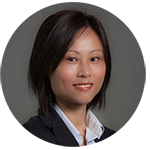
Jeanine Kwong, Global Head of Equity Risk at Manulife, talks with QuantMinds 365 about how we can get more women involved in quantitative finance.
 How did you start your career?
I was in a co-operative education program during undergraduate degree in Mathematics and Business Administration at the University of Waterloo (UW) that alternates periods of study with periods of work experience. After working as a quantitative analyst supporting equity derivatives traders at a Scotia Capital (A Canadian Broker-dealer) over two four-month work terms, I decided to pursue a career as a quant and completed a Master degree of Quantitative Finance also from UW. I worked at TD Securities for two years in Market Risk and the front office. In 2007, my life as a quant in an insurance company began when I moved to Japan and worked as a quantitative financial risk manager at ING Life (now NN Life) Japan. In April 2011, shortly after the Tohoku Earthquake, I was promoted to lead the Financial Engineering team in the division that is responsible for Variable Annuity (VA) hedging. That was when my career as a people manager began. I worked in Tokyo for 7 years then moved to the Netherlands and worked at ING Re as a VA hedging strategist. In October 2014, I moved back to Canada and has been in my current role as the Global Head of Equity Risk Oversight at Manulife since then.
What was your lightbulb moment?
As a kid growing up in Hong Kong, I was fascinated by the stock markets in real-life and on TV dramas. The basic recipe of a great TV plot line would be for the hero to speculate in cash and futures markets, lose everything, then somehow make his (it’s always a he) great come back. The lightbulb moment for the 5-year-old me was that stock market is risky and if you borrow money to speculate you can lose everything. In 1997, my last year in high-school and as I was about to choose what to study in university, the Asian Financial Crisis happened. The interconnectedness of the currency, equity and interest rate markets in response to macroeconomic policies intrigued me. I wanted to learn more about how markets work and how they are related.
Why do we see so few women in quantitative finance? (or finance in general)
The desire to be perfect in everything we do and risk aversion may contribute to seeing fewer women in quantitative finance. We tend to be less comfortable sharing our ideas before they are 100% hammered out and error-free. We seek comfort in following existing rules and procedures rather than testing the boundaries of those rules and challenging assumptions.
What advice do you have for women starting out their career in quant finance?
Speak up, ask why and clarify. Learn from those who are willing to share knowledge. Be persistent.
What will the future of quant finance/risk management look like?
Traditionally, financial markets behaviours are a collection of human decisions. As machines and algorithms automate trading decisions, risk manager should be more aware of the potential for a quant model to introduce negative feedback loops in the system.
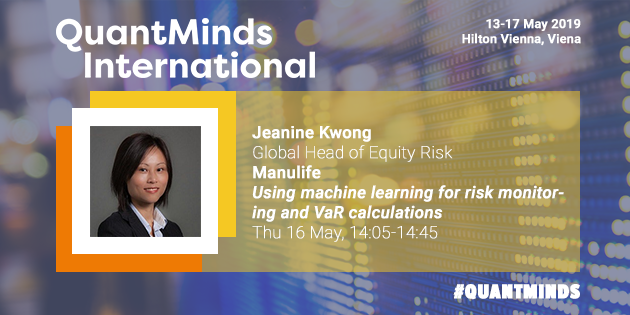
Jeanine will be at QuantMinds International this year and discuss using machine learning for risk monitoring and VaR calculations.