Private credit after the rate tailwind: What separates managers now?

Private credit has benefited from higher floating-rate income since 2022, but as the rate tailwind works through portfolios, the differences between managers are becoming clearer. Drawing on three charts from Preqin’s Performance Pulse: H2 2026, this article explores where performance has been strongest and why underwriting discipline may define the next phase. Nicholas Mairone, Vice President, Research Insights at Preqin, joins the speaker line-up at SuperReturn Private Credit North America as the industry considers what comes after the rate tailwind.
Key takeaways
- Private credit remains resilient: The asset class returned 8.3% over the 12 months to the first quarter of 2026, although quarterly momentum slowed.
- Mezzanine has led performance: It generated a cumulative return of 96.1% from the end of 2018 to the first quarter of 2026, compared with 72.9% for direct lending.
- Direct lending still dominates: The strategy accounted for approximately 63.5% of closed-end private credit capital raised during 2025.
- Access is widening: Evergreen vehicles, including business development companies in the US, are bringing private credit to a broader range of investors.
- Manager selection is becoming more important: Recent vintages display the widest return dispersion in more than a decade.
A resilient market, but slower momentum
Private credit has been one of the most resilient private market asset classes since the Fed began raising rates in 2022. That resilience continued through the easing cycle that began in September 2024.
Higher base rates boosted floating-rate income, while the default cycle many investors expected after rates rose rapidly has yet to materialise.
Private credit returned 8.3% over the 12 months to the first quarter of 2026. Momentum slowed during the quarter, however, with returns advancing by just 0.5%.
Even so, private credit compared favourably with the leveraged loan market, which declined by 0.6% over the same quarter.
Over the longer term, the Morningstar LSTA US Leveraged Loan Index generated a cumulative return of 52.1% from the end of 2018 to the first quarter of 2026. Although leveraged loans are not a direct benchmark for private credit, they provide the closest public-market comparison for senior lending strategies.
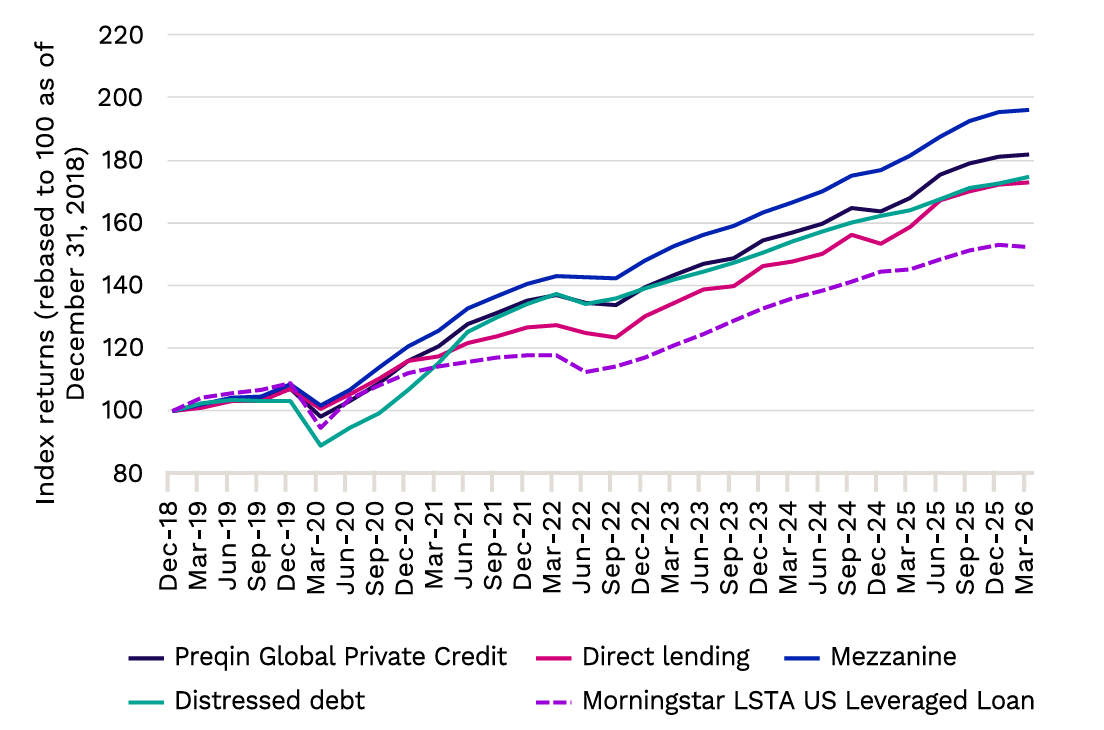 Private credit maintains steadily increasing performance
Note: Private market indices reflect time-weighted returns, net of fees, and capture closed-end funds only. Public-market index returns represent index performance and do not reflect investment-management fees.
Source: Preqin, Morningstar, data as of July 2026
Mezzanine led the pack
The overall private credit return conceals meaningful differences between strategies.
Mezzanine has outperformed direct lending since the end of 2018, producing a cumulative return of 96.1%, compared with 72.9% for direct lending.
Higher contractual yields helped, as did occasional equity participation and a credit environment in which defaults remained below expectations.
Performance differences between direct lending, mezzanine and distressed debt widened most noticeably during 2021 and 2022, when markets moved from an extended period of exceptionally low interest rates to a materially higher-rate environment.
Since the second half of 2023, those differences have generally become less pronounced, although periodic divergence remains.
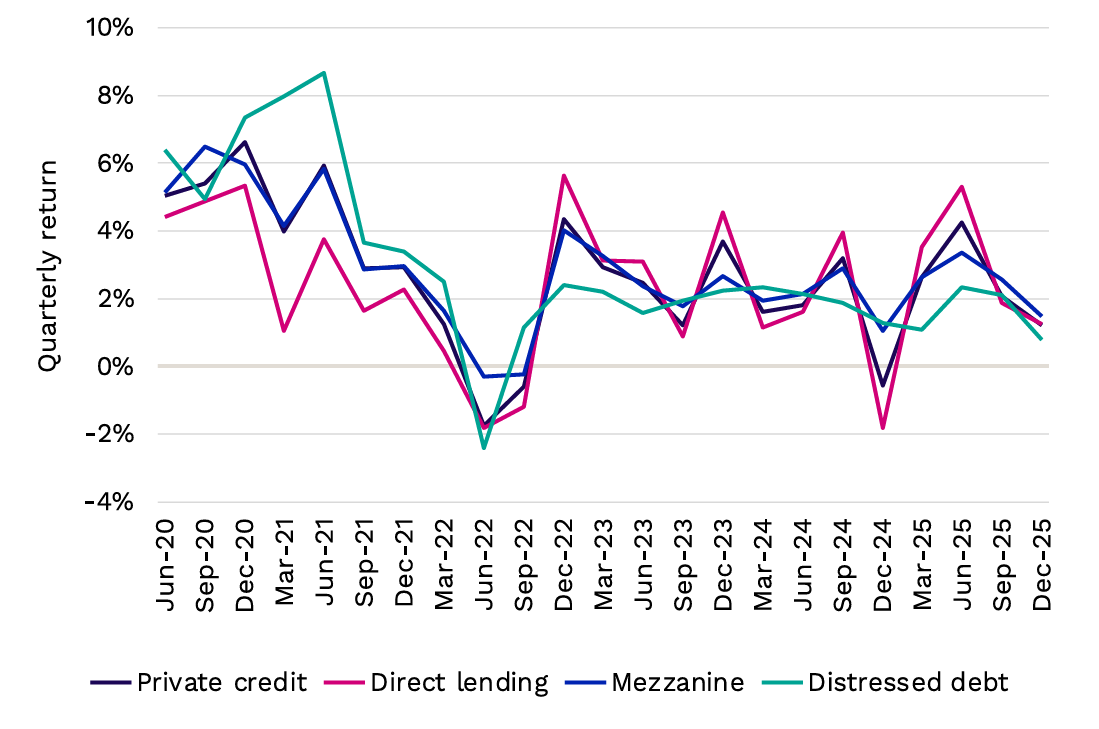 Quarterly returns for credit strategies are converging
Note: Private market indices reflect TWR, net of fees, and capture closed-end funds only
Source: Preqin, data as of July 2026
More ways into private credit
Evergreen vehicles, including business development companies in the United States and European long-term investment funds in Europe, are opening private credit to a broader investor base as more investors look for sources of yield.
Direct lending remains the largest part of the market. It accounted for approximately 63.5% of closed-end private credit capital raised during 2025, according to Preqin data.
Capital is also moving into other strategies. Distressed debt fundraising has gained momentum compared with 2024, while mezzanine fundraising is increasing as allocators seek downside protection alongside upside potential.
Preqin fundraising data captures closed-end funds only. Data as of 8 September 2026.
Recent vintages are starting to separate
Private credit typically exhibits much narrower return dispersion than private equity or venture capital. Recent vintages, however, show the widest dispersion in more than a decade.
Some of this is expected. Younger funds’ internal rates of return are more sensitive to valuations and early cash flows, and the gap may narrow as those funds mature. But the widening could also indicate that differences between managers are becoming more consequential.
As the benefits of higher rates become increasingly reflected across portfolios, performance is likely to depend more on underwriting discipline, sector expertise and portfolio construction.
Lower credit spreads raise the stakes further. When lenders are paid less for taking credit risk, there is less room for error, and downside protection becomes more important to LPs.
As the broad benefits of higher interest rates are increasingly reflected across portfolios, performance differentiation is likely to depend more on underwriting discipline, sector expertise and portfolio construction than on the rate environment alone.
Performance Pulse: H2 2026, Preqin
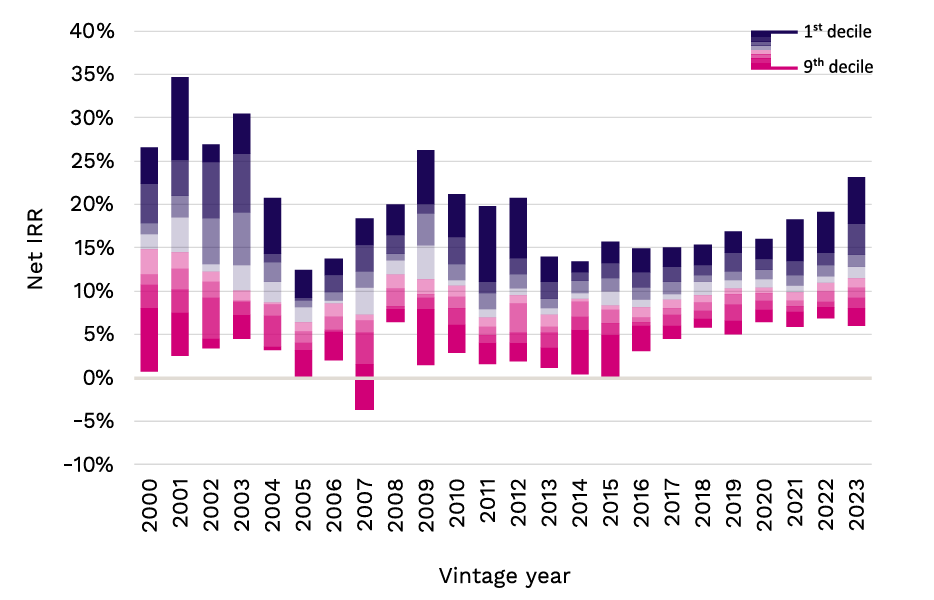 Recent private credit vintages show wider, but less mature, IRR dispersion
Source: Preqin, data as of July 2026
Banks are rivals - and partners
The boundary between private credit and traditional lending is becoming less distinct.
Private credit managers are increasingly financing larger borrowers that would historically have turned to syndicated markets. Banks are competing for some of the same transactions, but they are also working with private lenders through origination partnerships, co-lending and other financing arrangements.
This could broaden the opportunity set for private credit. Whether it improves returns will depend on a more difficult question: can attractive lending opportunities grow as quickly as the capital competing to finance them?
The next phase of the market is likely to depend less on broad market tailwinds and more on managers’ ability to source resilient borrowers, structure attractive transactions and preserve capital.
Performance Pulse: H2 2026, Preqin
What comes next?
Higher rates provided a broad lift to private credit, but that advantage will not distinguish one manager from another indefinitely.
As competition increases and credit spreads narrow, investors will need to look more closely at how managers source borrowers, structure transactions and protect capital. The next phase will be less about riding the same market tailwind and more about what individual managers can deliver.
Want to hear more? SuperReturn Private Credit North America takes place from 16–18 November 2026 at Convene, Madison Avenue, New York. Join the private credit community to explore what is next for direct lending, evergreen structures, the private wealth channel, credit secondaries and the wider lending market.
The information presented in this article is for information purposes only and does not constitute and should not be construed as a solicitation or other offer, or recommendation to acquire or dispose of any investment or to engage in any other transaction, or as advice of any nature whatsoever. If the reader seeks advice rather than information then it should seek an independent financial advisor and hereby agrees that it will not hold Preqin Ltd. responsible in law or equity for any decisions of whatever nature the reader makes or refrains from making following its use of this article. While reasonable efforts have been made to obtain information from sources that are believed to be accurate, and to confirm the accuracy of such information wherever possible, Preqin Ltd. does not make any representation or warranty that the information or opinions contained in this article are accurate, reliable, up to date, or complete. Although every reasonable effort has been made to ensure the accuracy of this publication, Preqin Ltd. does not accept any responsibility for any errors or omissions within this article or for any expense or other loss alleged to have arisen in any way with a reader’s use of this publication.