'The glass ball theory': Insights from the Women & Wine session at IMN’s RE Private Funds conference

"Sessions like Women & Wine add another layer of value because they create space for honesty and connection alongside the technical discussions."
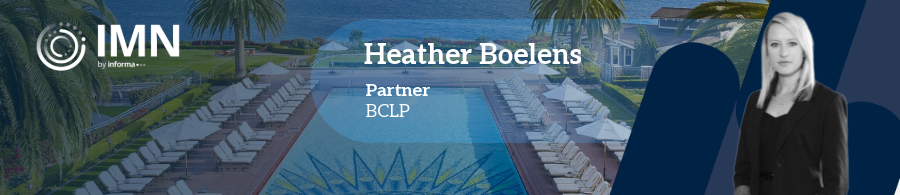
For multiple years, Heather Boelens, Partner at BCLP and Marie Murphy, Principal and CEO, MJD have led the Women & Wine workshop at IMN's Real Estate Private Funds conference. With attendance growing each year - here are Heather's takeaways from the session.
1. Tell us about yourselves and the Women & Wine session you led yesterday at IMN’s Real Estate Private Funds conference.
I am Partner in the Boulder and Denver offices for BCLP, a full-service international law firm. I practice in the area of commercial real estate and spend most of my time working with private funds, sponsors, and investors across the CRE ecosystem. With more than 350 real estate lawyers across 32 offices, in 2025, our global real estate team advised across every major asset class, from data centers and retail, to multi-family, industrial, office, and hotels, on transactions spanning over 50 countries.
Like many women in this industry, I’ve navigated a career that’s both demanding and incredibly rewarding. That personal experience really shaped this session.
The Women & Wine session was designed to be candid and interactive. We centered the discussion around the “glass ball theory”, which is a metaphor for how we think about work–life balance. Instead of assuming everything has to be perfectly juggled all the time, we talked about identifying which responsibilities are truly ‘glass’ — which are the ones that can’t be dropped — and which are ‘plastic’ and can flex without breaking. The goal wasn’t balance as perfection — it was balance as prioritization.
2. What were the standout takeaways from the session? Was there anything new you learned and how did attendance compare to previous years?
One of the biggest takeaways was how differently the ‘glass balls’ look from person to person — and how freeing it is to acknowledge that. For some, a glass ball might be family dinner every night; for others, it’s being present for a critical work moment or protecting personal health.
What surprised me was how openly people shared moments when they intentionally let a plastic ball drop and how often that decision led to better outcomes, not worse ones. There was a lot of relief in the room.
Attendance was strong and engagement was high. This felt less like a panel and more like a conversation. People stayed, participated, and continued the discussion afterward, which to me is the best indicator that the topic really resonated. The room wasn’t focused on doing more; rather, it was focused on doing what matters.
3. How do you think mentorship programs can be improved to better support women in the industry? Are there any personal experiences you can share?
Mentorship works best when it’s intentional and two-directional. Too often it’s informal or based on availability rather than alignment. Programs improve when they focus on specific goals. That could be career progression, confidence in the room, business development, or leadership visibility.
One thing I’ve found personally is that the most impactful mentors weren’t always the ones with the biggest titles. Instead, they were the ones who were willing to be honest about tradeoffs, missteps, and timing. That kind of transparency is invaluable.
I also think sponsorship is just as important as mentorship. Mentors give advice; sponsors create opportunities. Women benefit most when they have access to both.
4. What are some of the biggest challenges women in CRE face today, and how can the community work together to create more opportunities for growth and success?
One of the biggest challenges is still visibility. In particular, being seen as a decision-maker, a capital partner, or a leader, and not just a participant. That often shows up in who gets invited into rooms, who’s put forward for opportunities, and whose voice carries weight.
Another challenge is the unspoken expectation to ‘do it all’ without acknowledging tradeoffs. That’s where frameworks like the glass ball theory are powerful — they normalize prioritization instead of perfection.
5. What do you enjoy or find most valuable about attending this conference?
What I value most is the intersection of capital, strategy, and relationships. This conference brings together people who are actually shaping deals, not just talking about trends.
It’s also a space where conversations feel practical and forward-looking. You leave with real insights you can apply. And just as importantly, relationships that continue well beyond the conference.
Sessions like Women & Wine add another layer of value because they create space for honesty and connection alongside the technical discussions.
Join IMN's LinkedIn community - Learn more.
See the upcoming schedule - Learn more.