Posted by IMN on 27 November 2026
AI in land development: Your priorities, their insights

Artificial intelligence is creating new opportunities across real estate, but where could it make the biggest difference to land teams?
From identifying potential sites to assessing feasibility and navigating entitlement, AI has the potential to change how land development decisions are made. But putting the technology to work effectively is another challenge.
We asked the IMN LinkedIn community where they see the biggest opportunity for AI in land leadership. The results highlighted a clear priority: making AI work for the people and processes behind the deals.
The poll results
Where could AI make the biggest difference to land leadership?
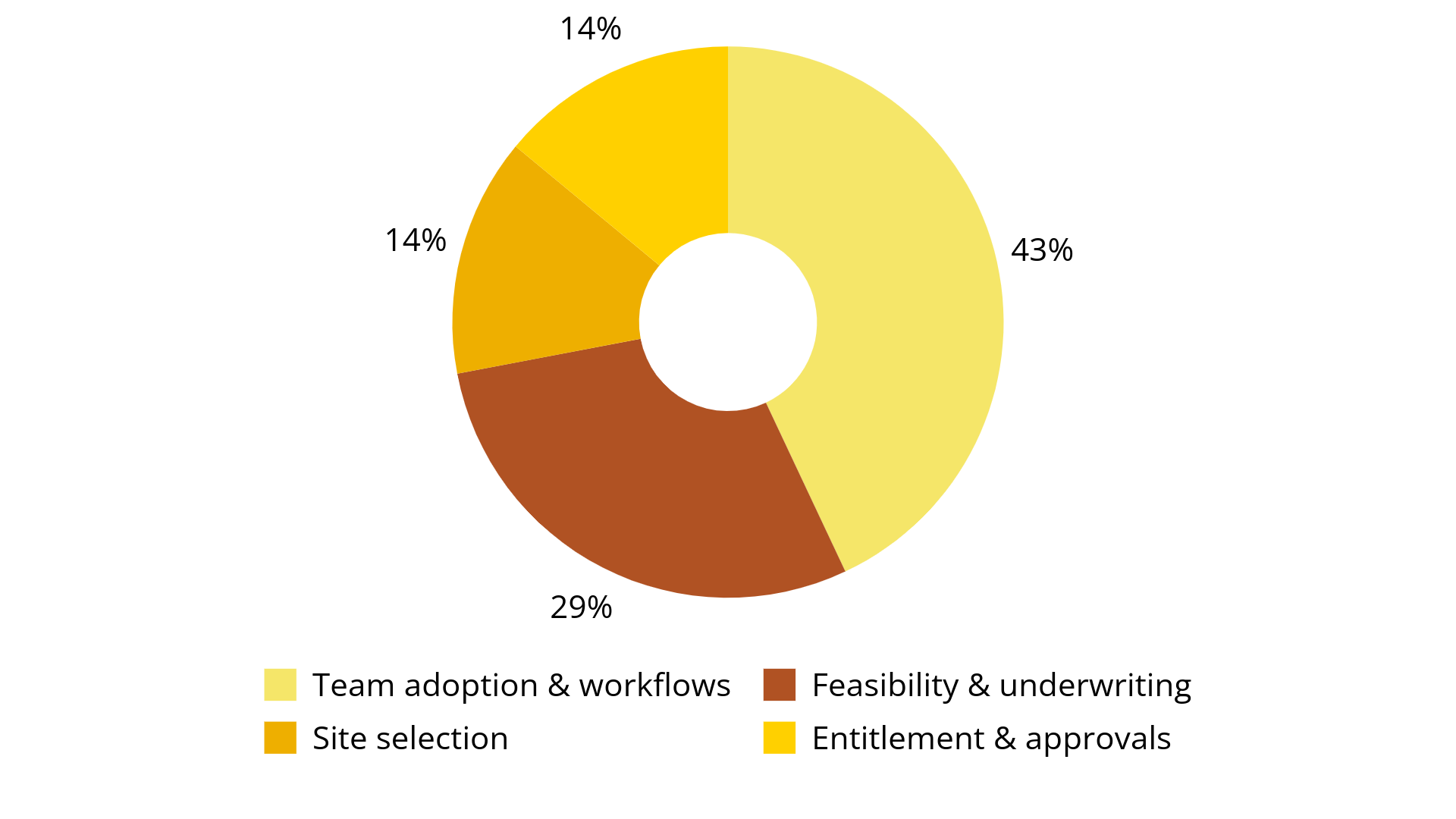
Team adoption and workflows came out on top, with 43% of respondents identifying this as the biggest opportunity. Feasibility and underwriting followed at 29%, while site selection and entitlement and approvals each received 14%.
Here's how the votes broke down:
- Team adoption and workflows: 43%
- Feasibility and underwriting: 29%
- Site selection: 14%
- Entitlement and approvals: 14%
The results suggest that while AI's potential across individual stages of land development is clear, integrating it into everyday operations is where many see the greatest opportunity.
But how does that translate into practice?
At IMN's Residential Ground-Up Construction Fall 2026, the session “AI & Land: Where Land Leadership Is Winning – and Where It's Not” brought together:
- Moderator: Matthew Kligerman, CEO of Dirt
- Jay Byce, SVP and Co-Founder of ResiBuilt
- AJ Colasurdo, Director of Land Development at Jim Chapman Construction
The discussion explored where AI is already delivering value, where adoption is proving more challenging, and how land teams can make better use of the technology.
Team adoption & workflows: Making AI part of the process
With 43% of respondents identifying team adoption and workflows as the biggest opportunity, the poll highlighted a key question for land leaders: how can AI become part of the way their teams operate, rather than simply another tool to use?
Matt argued that the greatest opportunity lies in rethinking entire workflows around AI, rather than using it to speed up individual tasks. The panel shared several examples of how businesses are beginning to put this into practice:
- Daily tasks and administration: Using AI for daily briefings, managing emails and documenting meetings through Read AI.
- Staff development and internal processes: AI can also play a vital role for staff development and standardising operating procedures internally.
- Automating repetitive work: AJ is experimenting with different agents, including a lien waiver agent intended to take some of the repetitive work out of everyday processes.
- Starting with small wins: Matt highlighted AJ's approach of identifying manageable opportunities first, rather than trying to change everything at once, and using those early successes to explore other workflows.
- Connecting tasks through AI agents: Matt also delved into the process of how agents could work together across a land pipeline, from sourcing leads to feasibility assessments and concept plans, with each stage passing work to the next.
To illustrate the potential, Matt compared AI adoption with the introduction of electricity in factories. Simply replacing a steam engine with an electric motor brought some efficiencies, but the bigger productivity gains came when factories redesigned their workflows around electricity.
The discussion suggested that successful adoption does not have to mean transforming an entire business overnight. It can start with identifying repetitive tasks and building from there. The longer-term opportunity is to connect those improvements and rethink how work moves through a land team.
Feasibility & underwriting: Identifying risks earlier
Selected by 29% of respondents, feasibility and underwriting was the second-highest priority in the poll. For land teams assessing potential acquisitions, AI could help bring more due diligence into the early stages of a deal, making it easier to identify potential issues before committing further time and money.
The panel shared several examples of how this is already being applied:
- Reviewing potential deal-breakers earlier: Matt described how Dirt customers are using AI to examine prior land use, sewer and infrastructure capacity, and municipal considerations earlier in the feasibility process.
- Reducing time spent on desktop due diligence: AJ explained that work involving zoning and environmental data, which could previously take two to three hours, can now take minutes using Dirt AI.
- Processing site information more quickly: AJ also said that using the site plan feature to assess density could reduce site processing from six hours to around 30 minutes, compared with the process involving an outside consultant.
- Checking rental restrictions: The process of using AI to review rental restrictions that may appear in zoning codes, zoning conditions or the wider public record was highlighted as an upcoming process by Jay. His team uses a checklist of more than 40 points, although he noted that AI cannot yet answer every item.
- Passing on unsuitable opportunities: Jay explained that AI helps his team double-check information received from brokers and identify potential failure points earlier. As a result, the business is sending around 20–30% fewer LOIs than it might have previously, avoiding time spent pursuing unsuitable communities.
Matt also highlighted the potential for AI-generated concept plans to support early feasibility work. These are not intended to replace final site plans, but to provide an initial density and yield estimate based on zoning and environmental constraints, the developer's buy box and preferred product type.
However, it is important to note that the discussion also highlighted some important limitations:
- Not all information is publicly available: Knowledge from previous developers, private conversations, and information that has never been formally recorded can influence whether a site is viable.
- AI-generated plans still need human input: Decisions around design quality, aesthetics and what a development should optimise for require judgement that AI cannot fully replicate.
- Early estimates are not final plans: The need for continued collaboration with architecture and engineering firms to develop concept plans into higher-fidelity final designs.
The discussion showed how AI can help teams identify potential issues earlier and reduce the time spent assessing opportunities. But faster analysis does not remove the need for experienced professionals to interpret the findings, understand the context, and decide whether a deal is worth pursuing.
Site selection: Finding opportunities that fit the buy box
Site selection received 14% of the votes. While it accounted for a smaller share of responses, Matt's examples highlighted how AI can help developers identify opportunities that align more closely with their acquisition criteria.
The panel detailed how customers can use AI to search for sites that meet their specific buy box requirements, including:
- Screening against acquisition criteria: Developers can bring their firm's specific land strategy and underwriting criteria into search tools, helping identify sites that may have been difficult to find through traditional searches.
- Assessing infrastructure access: Search criteria can include a site's distance from sewer and water infrastructure.
- Considering rezoning potential: AI can help assess the likelihood of rezoning based on historical information and political will within a municipality.
- Looking beyond current site conditions: Matt discussed the potential for agents to monitor municipal changes, such as moratoriums and sewer expansions, and identify how these developments could affect future sourcing opportunities.
However, Matt also highlighted a limitation: AI does not yet have access to all the information needed to identify land that may become more valuable in the future. Planned infrastructure, future road access, and the political will behind potential rezoning decisions can all influence development prospects, but this context is not always available in public data.
The takeaway is that AI can help developers search more effectively and narrow down potential sites, but understanding future opportunities still requires information and judgement that may sit outside the available data.
Entitlement & approvals: Understanding the local landscape
Entitlement and approvals also received 14% of responses. With decisions often shaped by local planning processes and municipal priorities, Matt honed in on how AI can help developers understand the history behind previous decisions and prepare for potential objections.
Examples included:
- Reviewing historical decisions: AI can analyse previous voting records for similar rezoning projects, upzonings, and variance requests to help teams understand how applications have been received.
- Tracking changes in decision-makers: Teams can examine whether the same board members or commissioners involved in previous decisions are still in place.
- Identifying recurring objections: Public hearing videos and meeting minutes can be reviewed to understand the opposition raised against similar proposals.
- Preparing proposals with more context: By identifying previous concerns and understanding how similar applications have been assessed, developers can consider those issues when shaping a new project.
However, Matt stressed that relationship-building and information held outside the public record remain important parts of the entitlement process. He also highlighted the value of capturing the knowledge that experienced team members have built through years of previous rezoning attempts, successes and failures, rather than leaving that information solely with individuals.
AI can help teams research previous decisions and arrive better prepared, but it cannot replace the local relationships and experience that influence how projects progress.
A changing role for AI in land development
The poll results provide a snapshot of where the IMN LinkedIn community sees the greatest opportunity for AI in land leadership. The panel discussion added practical context, showing how the technology is being applied across workflows, feasibility, site selection and entitlement.
Ultimately, the question for land leaders is not simply where AI can save time, but how it can help their teams make better decisions, manage risk and work more effectively. The technology is developing quickly, but knowing where to apply it – and where human expertise is still needed – will remain central to getting the most from it.
The conversation doesn't end here. Join us at IMN's Land & Homebuilding Capital Markets West in Las Vegas this January to explore the investment, development and financing strategies shaping the future of land and homebuilding.