That Magic Moment: Redefining Elevated Service for Today's Catering Clients
By Amber Kispert
In a world where Instagram-worthy food presentations have become the norm, savvy caterers know that what truly sets them apart isn't just what's on the plate—it's how that plate arrives to the table. As client expectations continue to evolve in our post-pandemic landscape, the art of service has emerged as the new battleground where catering companies are fighting to distinguish themselves from the competition.
"Good service is just the bare minimum buy-in," explains Jeff Ware (Catering by Michaels*). "It's the little touches on top of it that really set caterers apart."
Those little touches are making big waves across the industry as caterers invest more resources into training, choreography, and personalization. Let's dive into how today's most successful catering companies are transforming service from an afterthought into the main event.
Service styles: finding the perfect match
The debate between plated, family-style, and station service has evolved beyond simple logistics into a strategic decision that shapes the entire event experience. Each style offers distinct advantages that savvy caterers are leveraging to create memorable moments.
Plated service remains the gold standard for formal affairs, but even this traditional approach is getting refreshed.
"What I like as a high-end touch is a choice of entrée on site," notes Ware. "It's a very different touch, more like a restaurant experience."
This tableside selection elevates the guest experience while creating an interactive moment that breaks from convention.
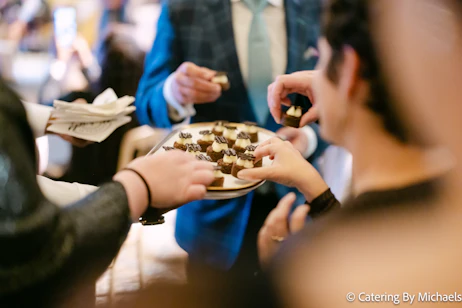
Meanwhile, food stations have evolved from simple buffet alternatives into immersive experiences. The most innovative caterers are designing stations that tell a story, invite interaction, and create ‘Instagrammable moments’—those picture-perfect interactions that guests can't help but share.
Family-style service continues to gain popularity for its ability to foster connection while maintaining an elevated feel. The communal nature encourages conversation while still allowing for sophisticated presentation and personalized attention.
Current service trends: casual sophistication reigns supreme
Perhaps surprisingly, one of the most notable trends in high-end catering currently, isn't about adding formality—it's about stripping it away while maintaining excellence.
"We've seen a general casualization of service," observes Ware. "Even fine dining restaurants don't need to have white tablecloths. Michelin-level restaurants don't need to tuxedos. It's casual and comfortable."
This shift toward approachable luxury doesn't mean lowering standards. Instead, it's about creating authentic connections between staff and guests.
“So much of what made hospitality great and even defined the word is a lost art," Lisa Ware (Catering by Michaels*).
She notes that while food quality has been elevated across the industry, the human element of service often gets overlooked.
"Service is more felt than seen," Jeff Ware adds.
The emotional experience of being served leaves a more lasting impression than the technical execution alone.
Training for excellence: The synchronized service showcase
Perhaps no service style demonstrates a caterer's commitment to excellence more visibly than synchronized service—that choreographed moment when every guest at a table receives their plate simultaneously.
"It is clean, elegant, and visually striking," explains Chris Sanchez (LUX Catering & Events*). "It signals discipline, timing, and care. But it is not just about optics, it is about respect."
Executing this service style requires significant investment in training and practice. Catering by Michaels recently demonstrated the power of synchronized service during the Leading Caterers of America Executive Summit, where they orchestrated service for 200 guests with 100 staff members.
"We had a meeting at our office several weeks in advance with all of the leads to get everyone on the same page," Jeff Ware explains. "The day of the actual event, we built in a ton of practice time, brought the staff in way earlier than we needed to—we had three hours to practice."
This level of preparation illustrates the commitment required to deliver truly elevated service.
Client expectations: The new baseline
Post-pandemic, client expectations have undergone a dramatic shift. Flexibility tops the list of demands, with clients expecting caterers to accommodate last-minute changes without friction.
"After dealing with event cancellations and changing health guidelines, clients now value flexibility in contracts, cancellation policies, and guest count adjustments," explains Bridget Bitza (Butler's Pantry*).
Additionally, many caterers observed a significant increase in expectations for visible cleanliness and hygiene.
Beyond that, there has also been a lasting shift toward more personalized options, with clients expecting greater menu flexibility and dietary accommodations to meet a range of needs, including gluten-free, vegan, and allergy-friendly options. These expectations have become the new standard for what clients consider high-quality service.
"Clients are looking for memorable, Instagram-worthy experiences rather than just standard food delivery," notes Jacqueline Ilg, (Butler's Pantry*).
The "Unreasonable Hospitality" revolution
Will Guidara's philosophy of "Unreasonable Hospitality"—going above and beyond conventional service expectations to create magical moments—has found fertile ground in the catering world.
"Make as many little things just a little more awesome," Guidara (the 2025 Catersource + The Special Event keynote) advises. "The smallest enhancements to those least likely touch points can have the most impact."
His approach emphasizes that "raindrops make oceans" and "the smallest things matter" when creating memorable experiences. Guidara believes in making service feel personal.
"Make it feel like you are inviting someone over to your house for dinner," he says. "Being present is everything–caring so much about the person in front of you that you stop caring about everything else you need to do."
This approach isn't about grand gestures but rather about paying extraordinary attention to small details. It's about anticipating needs before they arise and creating moments of delight that guests weren't expecting.
"When people feel completely cared for, they relax. They're present. And that's when the magic happens," says Sanchez.
The most successful caterers are training their teams to look for opportunities to deliver these unreasonable moments—whether it's remembering a guest's preference from a previous event or creating a custom offering for someone with dietary restrictions that makes them feel specially accommodated rather than an afterthought.
Navigating service challenges in a changing landscape
Despite the industry's focus on elevating service, caterers face significant challenges in delivering on these ambitions.
"The entire political, socioeconomic situation has very rapidly shifted following COVID," notes Jeff Ware. "It became hostile towards service workers."
This shift has made recruiting and retaining skilled staff more difficult than ever. Caterers are responding by creating more supportive work environments and emphasizing the importance of the work.
"Actually teaching and coaching a team to have fun at work, to show authentic smiles and authentic relationships—that's how we're looking to over-deliver," Jeff Ware explains.
There's an importance to hiring for character over experience.
Beyond staffing challenges, caterers must navigate increasingly complex dietary requirements, venue limitations, and the pressure to create unique experiences for each client. The most successful companies are developing systems to manage these challenges without compromising on service quality.
Advice for caterers: investing in the human element
For caterers looking to elevate their service game, the experts offer clear guidance: invest in your people.
"Kindness, smiling faces, actually greeting people, saying ‘hello’, introducing yourself—the smallest things are having the biggest impact these days," says Lisa Ware. "You can teach anyone how to set a table, you can teach how to deliver a plate, but coaching how to be nice, that's different."
This focus on the human element extends to how caterers communicate with clients as well. During consultations, ask open-ended questions like "What kind of experience do you want your guests to have?" to uncover true expectations beyond the basics of menu selection.
The Future of Elevated Service
As we look ahead, the caterers who will thrive are those who recognize that service isn't just about logistics—it's about creating moments that matter.
"We approach it like choreography," says Sanchez. "Every server is assigned a specific mark and movement, just like in a ballet or any theatrical production. But behind that elegance is a highly structured system."
This blend of artistry and precision defines the new frontier of catering service. In an industry where good food has become the baseline expectation, the human connection fostered through exceptional service is becoming the true differentiator.
"We're celebrating people's most important nights,” says Lisa Ware, “and it's in our hands to make it great."
And that responsibility—to create moments of connection, joy, and surprise through thoughtful service—is what will continue to separate the good from the truly great in catering for years to come.
* Catering by Michaels, Butler’s Pantry, and LUX Catering & Events are proud members of the Leading Caterers of America, a consortium of the top catering and event planners throughout the United States and Canada.
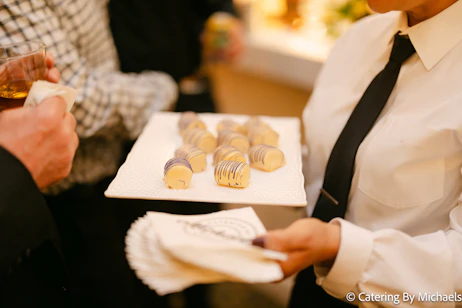
Photo Courtesy: Catering By Michaels
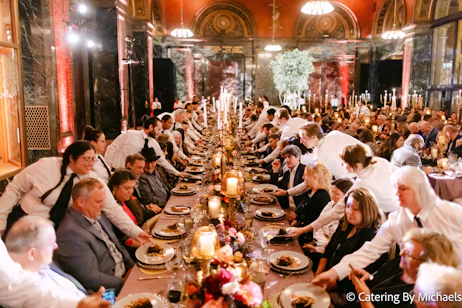
Photo Courtesy: Catering By Michaels

Photo Courtesy: Catering By Michaels