Partner content in association with Schroders Capital.
Continuation investments are frequently framed as a response to constrained exits. However, Schroders Capital’s research suggests that explanation is incomplete: the market has been expanding for more than a decade and is increasingly influencing how private equity managers retain strong assets, provide liquidity to existing LPs and finance the next stage of growth.
Featured in the latest edition of SuperReturn LP Insights, Nils Rode examines what is driving that expansion, what incoming investors may gain and why valuation, conflicts of interest and transaction structure still require scrutiny. Read the latest SuperReturn LP
Key takeaways
- Schroders Capital estimates that continuation investment volumes reached a record $109 billion in 2025 and could exceed $330 billion by 2035.
- Its analysis attributes only 9% of 2025 transaction volumes to cyclical pressures from the difficult exit environment, suggesting that the market’s growth is primarily structural.
- Continuation investments allow managers to retain control of selected businesses while giving existing LPs the choice to realise their investment or remain exposed.
- Greater familiarity with an asset may support due diligence and earlier liquidity, but it does not remove the need to scrutinise valuation, pricing, conflicts and transaction terms.

Exit pressure is accelerating a structural shift
Private equity has spent the past few years grappling with an exit problem. Higher interest rates, volatile markets and weaker M&A activity have made it harder for managers to sell assets - and therefore to return capital to investors.
Against that backdrop, the rapid growth of continuation investments has sometimes been interpreted as a symptom of a difficult market: an alternative route to liquidity when conventional exits are scarce.
Our analysis of industry intermediary reports shows that continuation investment volumes reached a record $109 billion in 2025, up from a revised $76 billion in 2024.
That interpretation, however, is oversimplified. Far from being a recent phenomenon, continuation investments have been riding a wave of structural expansion for more than a decade, with the market recording compound annual growth of 30% since 2013.
While the slower exit environment has undoubtedly created more opportunities, it has been an accelerant rather than the underlying driver of growth. Our research estimates that cyclical pressures associated with the weak exit environment accounted for only 9% of continuation transaction volumes in 2025, down from 14% a year earlier.
The implication is that continuation investments are not merely filling a temporary liquidity gap. Instead, they are becoming a structural feature of private equity.
Nils Rode, Chief Investment Officer, Private Markets, Schroders Capital
Our base-case analysis, and the key finding of our latest annual research, is that the market will expand more than threefold from its 2025 level to more than $330 billion by 2035. In a faster-growth scenario, it could expand more than fivefold. At the time of writing, activity in 2026 is already exceeding our forecast run rate.
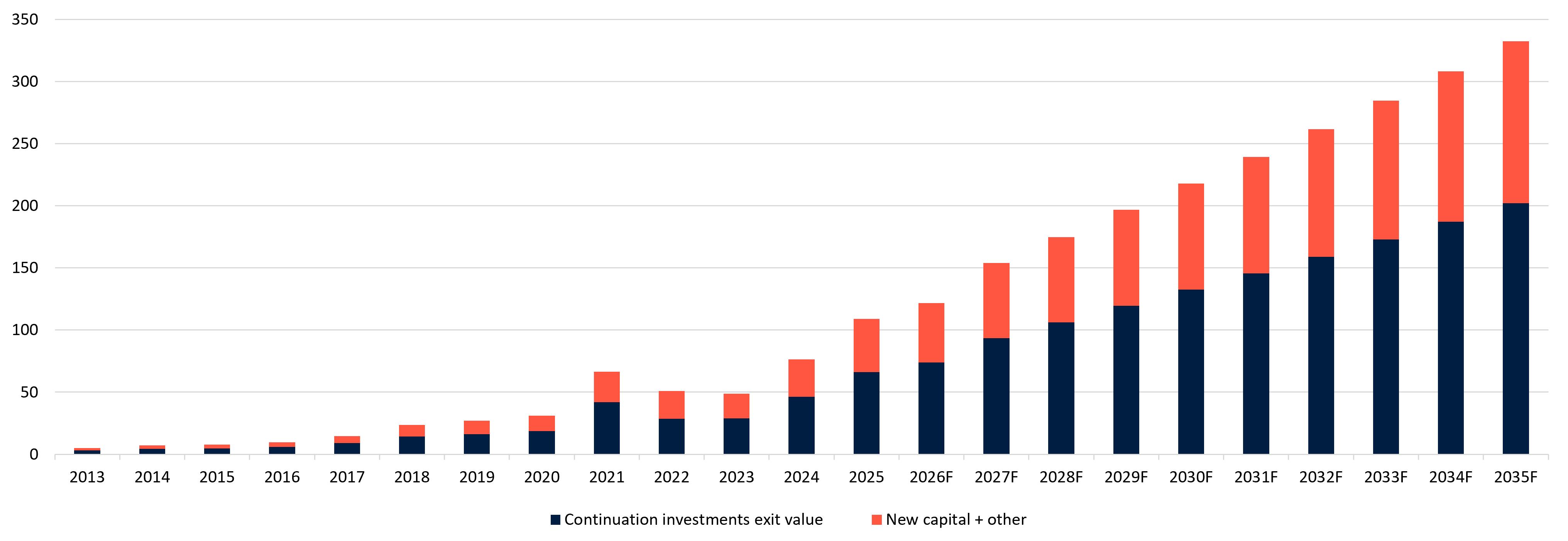 Continuation investment market to triple in size by 2035.
Source: Schroders Capital secondaries research, Preqin, Pitchbook, Jefferies, Greenhill, Evercore, Lazard, PJT. For full source notes visit here.Disruption in continuity: who owns the next stage of growth?
Although the rise of continuation investments has generated plenty of, often negative, headlines, there is nothing particularly novel about successful companies remaining under private equity ownership beyond their original holding period.
Sponsor-to-sponsor secondary buyouts, in which one private equity manager sells a company to another, have represented a substantial share of exits for more than two decades. They have averaged 38% of deal count and 36% of deal value since 2006.
What is changing is who owns the company during its next phase of growth.
Traditional private equity funds typically envisage a four-to-six-year value-creation period. But businesses do not develop according to fund timetables. A company may have successfully entered new markets, improved its operations or completed the first stage of a buy-and-build strategy while still having substantial growth ahead.
Historically, capturing that next phase often meant selling the company to another, generally larger, manager. Companies would therefore move up the private equity value chain.
A continuation investment offers another option. The existing manager can retain control while bringing in new investors and, often, fresh capital. Existing underlying investors can choose to realise their investment, while those wanting further exposure can remain invested.
Our analysis of around 2,600 realised buyout investments suggests that roughly 31% of portfolio companies could be candidates for continued transformation without requiring a new controlling owner. For the strongest businesses, we believe this continuity can itself be valuable.
But continuity can still be disruptive. Our research suggests that continuation investments could displace up to 5% of total deal flow for mid- and large-buyout houses over the next 10 years.
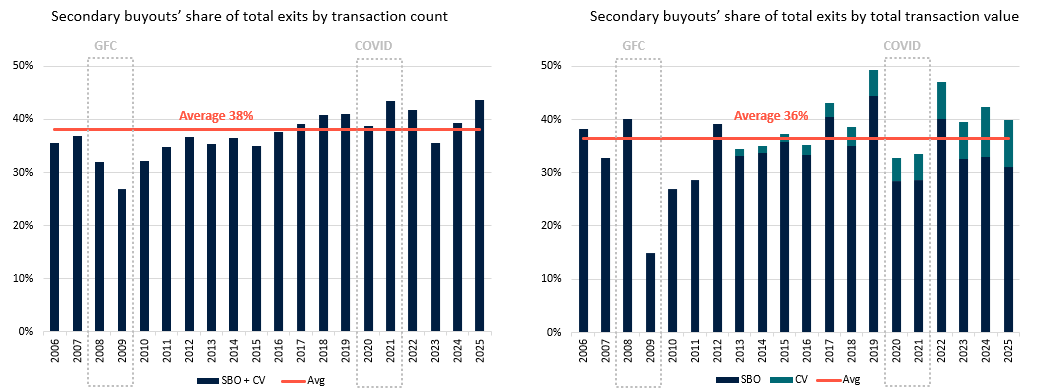 Private equity has been selling to itself for more than 20 years.
Source: Schroders Capital secondaries research, Preqin, Pitchbook, Jefferies, Greenhill, Evercore, Lazard, PJT. For full source, visit here
What incoming investors may gain
The appeal for incoming investors is also becoming clearer.
Continuation investments resemble traditional buyouts in that they are concentrated investments in individual companies. The difference is that they involve businesses that have already spent several years under private equity ownership.
Investors therefore have an operating history on which to conduct due diligence, rather than having to underwrite an entirely new asset and management relationship. This creates the potential to access buyout-like returns with secondaries-style risk mitigation.
Our realised investment data suggests that this can translate into a more predictable return profile with less tail risk than traditional buyouts. Evercore research covering 387 continuation funds formed between 2018 and 2024 similarly found broadly comparable returns with buyout funds, but with lower return dispersion.
Liquidity can also arrive sooner. Our data indicates that realised continuation investments have average holding periods approximately 1.5 years shorter than traditional buyouts, translating into roughly 35% faster time to liquidity.
Why greater familiarity does not remove risk
None of this removes the need for rigorous underwriting. A familiar company can still be a poor investment at the wrong price, while conflicts of interest and transaction structure require careful scrutiny.
For LPs, that scrutiny extends beyond the quality of the underlying asset to the valuation process, fee and carry arrangements, rollover terms, leverage and the time available to make an election.
The growth of the market makes selectivity more important, not less.
Nils Rode, Chief Investment Officer, Private Markets, Schroders Capital
A new part of private equity’s architecture
Continuation investments challenge a longstanding assumption in private equity: that realising value from a successful investment necessarily requires selling it to somebody else. Increasingly, managers and investors have another choice.
The difficult exit environment may have accelerated that change. It did not create it.
As private equity matures, continuation investments are becoming less an alternative to the traditional buyout model and more a part of its value-creation architecture.
Read the full research: Continuation investments continue to grow and reshape the buyout market.