European private equity entered the second half of 2026 with lower deal and exit activity, more expensive financing and an increasingly selective fundraising environment. However, the headline figures do not tell the whole story.
Ahead of SuperReturn Europe, Nicolas Moura, Senior Analyst, EMEA Private Capital Research, PitchBook draws on PitchBook’s latest Q3 2026 European PE Breakdown to examine what changing entry prices, record UK take-private activity and concentrated fundraising reveal about the market.
Key takeaways
- Deal and exit activity slowed: European private equity deal value fell 11% quarter-on-quarter in Q3 2026, while exit value declined by 25%.
- Entry prices became more favourable: The median European M&A EV/EBITDA multiple fell to 8.9x despite higher borrowing costs.
- UK take-private activity accelerated: European take-private deal value reached €52.8 billion, with the UK accounting for close to 60% and US sponsors playing a significant role.
- Fundraising became more concentrated: European private equity raised €65.9 billion across 99 funds, with capital increasingly flowing to larger, established managers.
Three charts that explain European private equity right now
European private equity had a quiet Q3: deal value fell 11% quarter-on-quarter and exit value dropped 25%, both pointing to a market that has slowed broadly rather than stumbled on a handful of failed processes.
The ECB’s two rate hikes this year, in June and September, are the clearest culprit, pushing up borrowing costs just as sponsors were trying to get deals away.
But a quieter quarter does not tell the whole story, and three charts from our latest European PE Breakdown reveal a more nuanced picture than the headline numbers alone.
1. Lower pricing is working in sponsors’ favour
The median European EV/EBITDA multiple across M&A has fallen to 8.9x year to date, down from 9.8x in 2025 and roughly a full turn below the market’s recent peaks.
That is unusual: valuations typically hold up when deal volumes compress, since only the highest-conviction transactions get done. Instead, Q3’s slowdown looks like a cost-of-money problem rather than a shortage of good opportunities.
Entry prices have moved in buyers’ favour at exactly the moment when the debt used to fund them has become more expensive, setting up a more attractive entry point for the 2026 and 2027 vintages than this year’s deal count alone would suggest.
The flip side is a headwind for anyone selling an asset bought at 2021 to 2022 peak prices.
Entry prices have moved in buyers’ favour at exactly the moment when the debt used to fund them has become more expensive.
Nicolas Moura, Senior Analyst, EMEA Private Capital Research, PitchBook
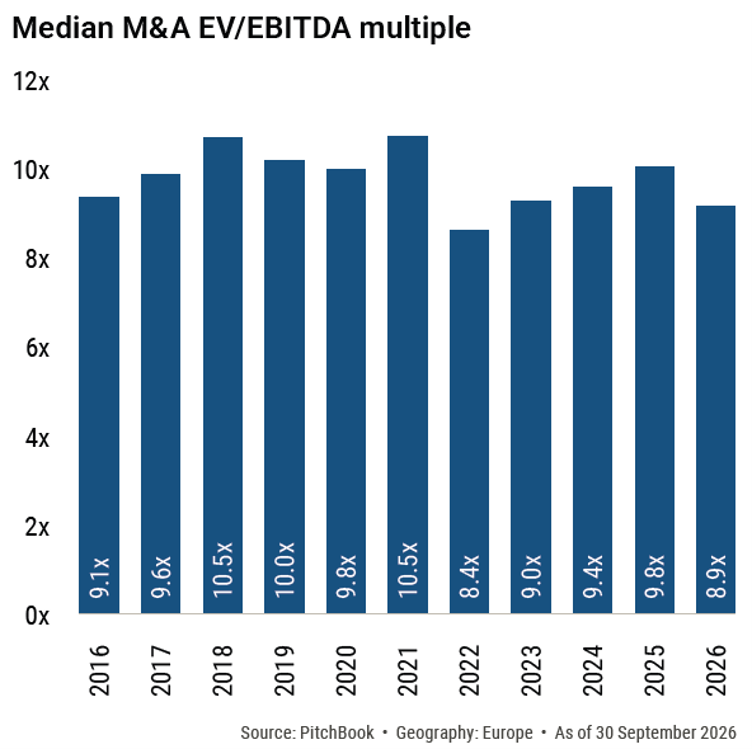
Bar chart showing the median European M&A EV/EBITDA multiple falling from 9.8x in 2025 to 8.9x in 2026 to date.
2. The UK is on course for its best take-private year on record
Take-private deal value has reached €52.8 billion so far in 2026, up 32% year-on-year, with the UK alone accounting for close to 60% of that.
Eight of the 10 take-privates completed in Q3 were UK companies, including Bodycote’s buyout, led by US firm Veritas Capital, and the consortium deal for Spire Healthcare Group, which included US investor Ares alongside its UK co-investors.
For now, the UK is doing most of the heavy lifting in Europe’s exit-via-delisting story, and US capital is doing much of the heavy lifting within the UK.
Nicolas Moura, Senior Analyst, EMEA Private Capital Research, PitchBook
That pattern fits a theme running through this year’s data more broadly: US sponsors are disproportionately behind Europe’s take-private wave, drawn in by a persistently weak London Stock Exchange that has left UK companies trading at a discount to their private-market and overseas-listed peers.
For now, the UK is doing most of the heavy lifting in Europe’s exit-via-delisting story, and US capital is doing much of the heavy lifting within the UK.
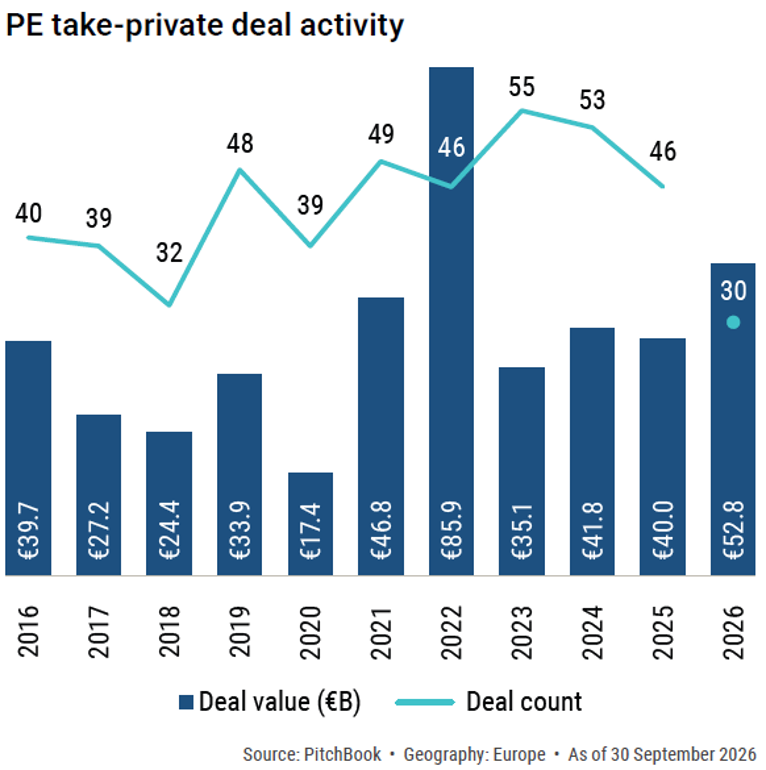 Chart showing European private equity take-private deal value and count between 2016 and 2026, with €52.8 billion of deal value recorded across 30 deals in 2026 to date.
3. Fundraising is consolidating, not collapsing
European private equity raised just €65.9 billion across 99 funds year to date, against €84.8 billion across 174 funds for all of 2025.
On the surface, that looks like a sharp decline. Look closer, though, and the picture is more about concentration than capitulation: capital raised already equals 78% of last year’s full-year total, from just 57% of the fund count.
LPs are not withdrawing from the asset class so much as consolidating around fewer, larger managers, and the median European private equity fund size has climbed close to a record €360 million as a result.
Established firms took 89% of all capital raised this year, while first-time fundraising has stalled. For managers with a track record, this is a selective market rather than a frozen one: Providence Strategic Growth Europe III closed at €4.4 billion, at the top of its target range, and the average step-up between a fund and its predecessor has risen to 1.9x, from 1.8x in 2025.
LPs are not withdrawing from the asset class so much as consolidating around fewer, larger managers.
Nicolas Moura, Senior Analyst, EMEA Private Capital Research, PitchBook
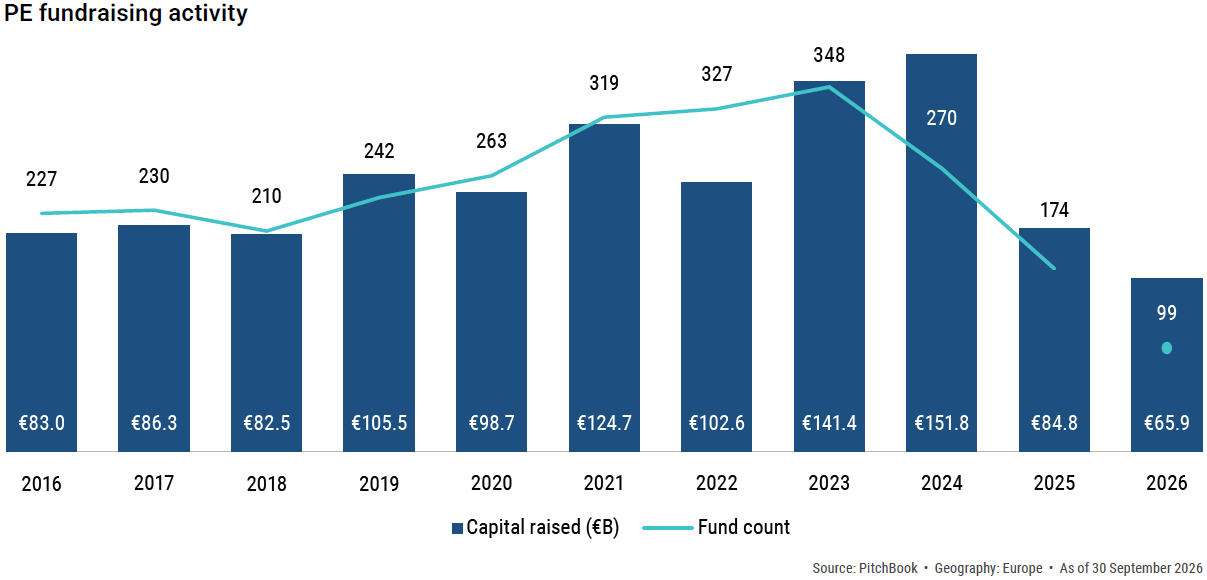 Chart showing European private equity fundraising between 2016 and 2026, with €65.9 billion raised across 99 funds in 2026 year to date.
A market rewarding patience and selectivity
Each of these charts tells a version of the same story: European private equity is not short of capital, pricing or opportunity; it is short of the financing conditions that would let all three come together at once.
The sponsors able to work around that constraint - by buying at better prices, concentrating on markets where financing is deepest or raising from LPs who already know them - are the ones having a good 2026.
The data points towards a market rewarding patience and selectivity over volume, in dealmaking as much as in fundraising.
Nicolas Moura, Senior Analyst, EMEA Private Capital Research, PitchBook
It is also worth noting how much of that financing depth is US-based. Deals with US investor participation reached a record 46% share of total European deal value in Q3, with nine of the quarter’s 10 largest deals carrying a US sponsor - a reminder of how much of the market’s resilience is currently imported rather than homegrown.
For anyone at SuperReturn Europe thinking about where to lean in next, the data points towards a market rewarding patience and selectivity over volume, in dealmaking as much as in fundraising.
Read the full report: Q3 2026 European PE Breakdown.
Want to hear more? SuperReturn Europe takes place from 3–6 November 2026 at Hotel Okura Amsterdam. Join Nicolas and other private markets leaders to explore where capital, opportunity and investor appetite are moving across Europe.