Posted by April Rudin on 29 May 2026
The importance of intergenerational communication for wealth managers

For decades, wealth management operated much like a monarchy. One advisor. One decision-maker. One relationship that mattered. Win the elders, keep the assets. This operating model won’t work with the next generation.
They may have attended the occasional review meeting, but they were rarely treated as meaningful participants in the conversation. Many sat quietly through discussions they neither understood nor wanted to attend. That traditional framework is increasingly out of sync with today’s families.
Roughly $124 trillion in wealth is expected to transfer through 2048, with more than $100 trillion projected to flow directly to heirs, according to Cerulli. Millennials alone are expected to inherit approximately $46 trillion, while Gen X is projected to receive another $39 trillion.
And yet, despite all the industry discussion around retaining assets, many advisors still operate as though those relationships automatically survive the transfer. More often than not, they don’t. Some industry estimates suggest that as many as 70% of heirs change advisors after inheriting wealth. The problem isn’t loyalty, it’s relevance.
If the next generation doesn’t know you, trust you, or understand the value you bring as an advisor, there is a very good chance they will leave – not because your investment performance failed, but because you never built a relationship with them in the first place.
The deeper issue is that today’s wealthy families no longer operate through the old single decision-maker model. Increasingly, they function as collaborative, multi-generational systems with multiple voices, priorities, and expectations around wealth. Advisors who still position themselves as the private counselor to one authority figure are solving for a family structure that barely exists anymore.
That shift changes the advisor’s role. Technical expertise alone is no longer enough to preserve continuity. Today, advisors must also communicate across generations, build trust early, and help families navigate increasingly complex conversations around wealth, responsibility, and legacy. Increasingly, that ability is becoming a differentiator in the marketplace.
Why is family communication now a competitive advantage?
For years, wealth management firms competed on performance, access, exclusivity, and technical sophistication. These things still matter, but in the era of the great wealth transfer, another differentiator is rapidly emerging: a firm’s ability to communicate effectively across generations.
Increasingly, the advisors who retain relationships are not simply the ones with the best investment strategy, they are the ones who can connect and build trust with an entire family system, not just the person currently controlling the assets. That requires a very different approach to communication.
Today’s wealthy families are more complex than ever. Multiple generations are involved in decision-making. Family members may live in different cities, countries, or even operate from entirely different worldviews around money, lifestyle, career, philanthropy, and legacy.
The firms getting ahead of this shift understand that communication itself has become a key part of the value proposition. They are proactively creating opportunities for younger generations to engage with advisors long before a wealth transfer occurs, through
- family education sessions,
- rising-generation workshops,
- philanthropy discussions,
- informal check-ins, and
- conversations focused on stewardship and family purpose, not just investment performance.
Most importantly, they recognise that younger generations want context. They want to understand not just what structures exist, but why they exist. They want transparency around decision-making, family values, and long-term vision.
The advisors doing this well are not just presenting information. They are fostering dialogue and helping families have conversations that many have historically avoided, about responsibility, expectations, legacy, and what wealth is actually meant to accomplish across generations.
Family meetings: Advisors’ #1 strategy to prepare for wealth transitions
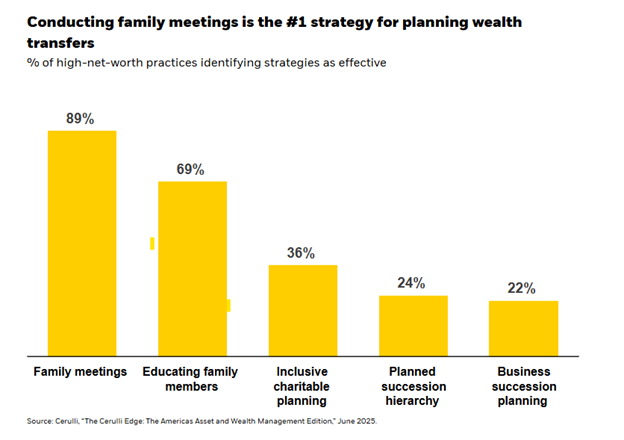
For all the discussion around technology, personalisation, and digital engagement, one of the most effective tools for strengthening intergenerational relationships is still surprisingly simple: getting families in a room together and having meaningful conversations.
In fact, according to Cerulli, the family meeting is the number one strategy advisors use to prepare families for wealth transitions.
Advisors tend to overload presentations with jargon, market commentary, and technical detail while completely missing the human dynamics in the room.
The better approach is to focus less on products and more on conversation:
- What does wealth mean to each generation?
- What responsibilities come with it?
- What concerns or anxieties exist around inheritance?
- What kind of legacy does the family actually want to create?
Younger generations are far more likely to engage when discussions feel authentic, collaborative, and relevant to their lives. And for the record: no one under 35 wants to sit through 83 slides on fixed income duration.
How do advisors stay relevant? They start early.
Too often, intergenerational communication gets treated as an occasional family meeting or an estate-planning discussion triggered by aging parents or a significant life event. But successful multigenerational engagement is not an event, it is an ongoing strategy. Families that communicate more openly and intentionally about wealth transitions, and do so proactively, are often better positioned to preserve both family cohesion and long-term stewardship.
Every generation reevaluates who they trust, how they engage, and what value means to them. The advisor-client relationship now must survive generational scrutiny, and that requires more than technical expertise. It requires emotional intelligence, communication skills, adaptability, curiosity, and the willingness to evolve beyond the traditional advisory model. If your first meaningful interaction with heirs happens after a death, illness, or liquidity event, you are already behind.
The advisors getting this right begin relationship-building years before wealth transfers occur – not through stiff formal introductions, but through consistent, low-pressure engagement over time. They invite adult children into selected meetings. They host educational workshops and rising-generation discussions. They create opportunities for conversations around philanthropy, entrepreneurship, stewardship, and family purpose. They provide financial education without condescension and most importantly, they stay connected.
Relationships with the next generation are not established in a single meeting. They are built gradually through communication, accessibility, and trust over time. Younger family members want advisors who can explain not just what strategies exist, but why they matter and how they connect to the family’s broader goals, values, and vision for the future.
Ultimately, intergenerational communication is not just about retaining assets. It is about maintaining relevance and strengthening relationships with the people inheriting them.
How can financial advisors modernise communications?
For younger generations, expectations around communication have changed dramatically. They expect communication that feels responsive, personalised, and human. Long delays, opaque language, and hyper-formal communication styles can feel disconnected from how people actually interact today.
The advisors winning with multigenerational families are using shorter, clearer communication, staying connected between meetings, offering more collaborative conversations, and speaking like humans instead of institutions. That last point matters more than many firms realise.
The future of wealth management will not belong to the firms with the most polished pitch books or the longest market commentary. It will belong to the advisors who can build trust across generations, facilitate difficult conversations, and remain relevant long after wealth changes hands.
Join the conversation and define the future of wealth at FundForum – the largest asset & wealth management event in the world!