Posted by IMN on 07 April 2026
How the BTR industry is navigating Trump's housing shake-up
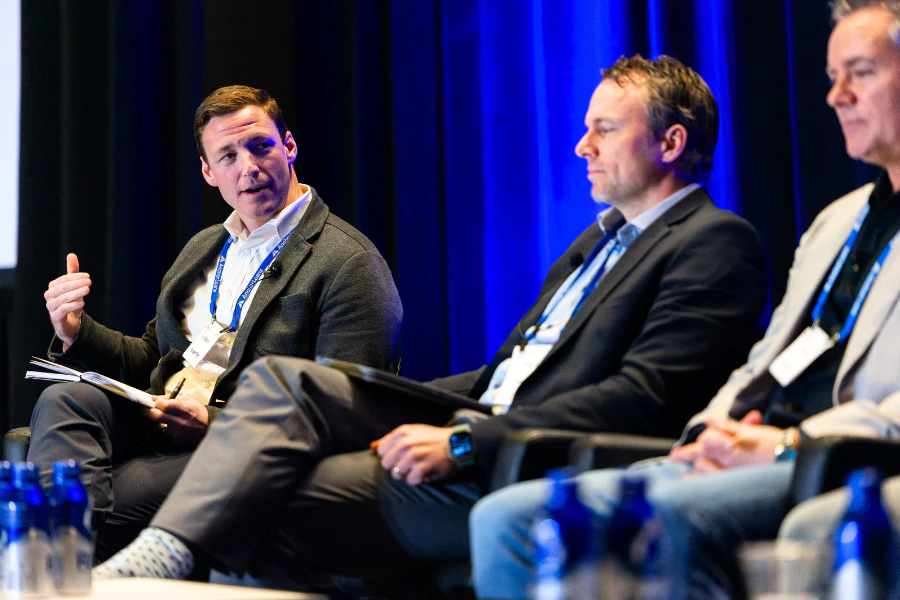
As the 21st Century ROAD to Housing Act returns to the House in an uncertain state, BTR developers and investors face a difficult calculation: hold back and wait for clarity, or push forward and protect against downside risk. This piece dives into a lively panel from the Build-to-Rent Spring Forum, where industry pros shared how they’re tackling the twists and turns of BTR investment in today’s unpredictable landscape.
“We fundamentally cannot discuss the new realities of our industry without touching on the political threats that have emerged, which threaten the viability of significant portions of this industry.”
This was the opening line from moderator Nick Beeson, Vice President, Acquisitions at Foulger Pratt, at the IMN Build-to-Rent Spring conference in Nashville, Tennessee, in March 2026. It set the scene for a robust discussion among distinguished panelists on the bipartisan 21st Century ROAD to Housing Act.
While aiming to increase housing affordability and supply, the bill, which has yet to be finalized, significantly impacts single-family rental (SFR) markets and build-to-rent (BTR). How was each member of the panel navigating the uncertainty? asked Nick.
Pencils down
Mike Bednarski, CEO at LyvWell Communities, said they had previously exited their SFR position, thus dodging that particular bullet. That said, they were in the BTR space and were monitoring developments closely. This included employing a risk-averse approach to the legislation:
“For the time being, we are trying to think about ways that we can make sure we have the single plat deals with three units or more per building, really fitting that box that the current legislation has. That’s the worst-case scenario. Base case, we still love individually platted deals, we love the duplexes, so hopefully they will remove that language.”
The panel agreed that investor appetite had been impacted.
“We're optimistic it's going to work through. So we're going full throttle on our deals,” added Mike. “Unfortunately, our capital is not; we're hearing from a lot of capital, it is pencils down, so that makes it difficult.”
Troy Mertz, President at Moda Homes, said that equity is on the sidelines: “It's essentially the roach motel. You can get into the trade, but how do you get out? How do you pay back that equity? That's been the struggle for the industry.”
David Platter, Co-CEO at Griffin Capital Company, agreed. “Capital markets are going to be fairly shut in the space until allocator types really understand where this is going.”
Was this a slippery slope to more housing policy shifts? asked Nick.
“I think we've started to internalize that the federal government is now a participant in this industry,” stated David, adding that the philosophy of the bill could be extended to multifamily.
Buy or build?
Nick then turned to the question of opportunity.
BTR offered limited opportunities to buy below replacement cost, said Mike. “And even if we do see them, they're not the ideal product or size, or there are issues with the community,” he said. “We prefer to build exactly what we want to manage and own, and the exact locations.” The timing for build worked in their favor, he added. “By the time we're in lease-up, we should be in a much healthier environment anyway.”
David agreed, saying that, while they were active on both acquisitions and development, activity had increased more recently on the development side: “especially seeing the end of the supply wave and delivering into an environment in 2027, 2028, 2029, that starts to feel better just from an operational perspective.”
Capital solutions
Multiple capital structures were discussed, with Mike saying that it’s easier to find buyers who will take over a project later than it is to find investors willing to fund new development from the start.
Hayden Glasstetter, Director, BTR at AvalonBay Communities, said that AvalonBay's Development Funding Program (DFP) currently had six deals underway in which they put up 100% of the capital stack, with completion and cost-overrun guarantees. The sponsor receives market development fees and an interest in the profit upside, which can account for 20-30% of those profits. The cost of capital for the DFP program is “around a six,” and they are happy to deploy this wherever they have a footprint.
David said their approach is more traditional, with developer partnerships often at 90/10 and market-rate development fees. They also invest in opportunity zones, holding the asset for 10 years or more. On the acquisition side, they close on balance sheet and then tend to syndicate through their DST platform.
The AI advantage
The legislation is not the only shifting landscape the industry faces. The use of technology, particularly AI, has the potential to transform operations.
“We’re thinking about it constantly, asking ourselves, how can we have AI solve this problem we're talking about in our typical weekly meetings,” explained Mike. It had been an interesting discovery process, he added.
For Troy, technology has allowed them to combine two large data sets - one from their leasing platform and another from their accounting software program - to deliver real-time data. “They're showing availability instantly, and so the message matches the reality, and that's been a dramatic step forward,” he said.
Largely, there was agreement that there is no one answer across the board.
As the panel concluded, the dominant mood in the room was not anxiety but adaptation.
As Nick Beeson put it, the industry is navigating purgatory, but as the panel proved, it is still navigating.
The Build-to-Rent industry is at a pivotal moment, balancing uncertainty with innovation and resilience. Continue this vital dialogue and collaborate on actionable solutions at the Single Family Rental East Forum this May in Miami. Let’s shape the future of housing together and ensure the continued growth and success of the BTR and SFR sectors!