


The ancillaries
We wrote at Europe's Open the broader USD stays well off recent highs of 110.54 and 100.12 (DXY) as OIL falls back towards the psychological Usd 100/brl mark and ahead of the FOMC announcement later.
Other ancillary/related markets though show the US stock futures all in green territory, led by the +0.6% NASDAQ at the time of writing, while pre-Fed the US 10-year yield trades south of 4.20%.
Conflicting signals?
We have talked this week of conflicting signals and Barclays suggest US stocks are flashing their strongest buy signal in almost a year, as Citi raise their near-term Brent forecast to Usd 110–120!
Does such relatively orderly trade, even relative optimism currently suggest markets continue to price out the prospects of a long war even as Bbg writes Israel’s killing of Ali Larijani puts Iran’s wartime leadership largely in hardliner hands, dimming prospects for a diplomatic offramp?
And, BBC News reports latterly the US military says it has used powerful 'deep penetrator' bombs to hit Iranian missile sites along the Strait of Hormuz, while Iran's army chief warns of a 'decisive' response after the death of security chief Ali Larijani, the most senior official to be killed since Supreme Leader Ali Khamenei. Also, overnight retaliatory strikes by Iran and its allied militia groups continue. In Israel, two people are dead in Tel Aviv and in Lebanon, Israel launches a series of deadly strikes in central Beirut and orders evacuations in southern Lebanon, as it continues its offensive against Hezbollah.
The headlines do not indicate an imminent end to conflict!
Neutral-to-bullish still?
In Monday's The USD Week - After the big break above 100 within an identified expected DXY USD Index trading range of 99.40 - 101.40.
However, it's been mostly downhill so far to 99.47 and testing that 99.45-50 previous resistance, now support area.
Through there, however, and perhaps we could see a further pullback/correction/return towards 98.35-40 and the 200-dma.
Our FOMC view & questions!
On tonight's Fed, we wrote Monday that a Fed rate cut by three meetings time in June stands at (22% last). For March, that figure is (around zero) and only a handful of the 93 respondents to a Bbg poll can see a move this week.
Last time out, in late January, the Fed adopted a slightly more hawkish stance in the removal of 'downside risks to employment rose in recent months' though the huge negative miss in Feb NFPs of -92k suggests this turn may have been a touch premature. Of course, the backdrop is changed even more going into this week's meeting, with war and spiking oil prices to contend with. Will such relative economic optimism/confidence continue? The December update saw one rate cut for 2026. Will the Fed distance themselves from such a move and even indicate a hike is now just as likely as a cut?
What of Jan's two dovish dissenters - Miran and Waller? Has the oil spike led to a reassessment?
And the other central banks!
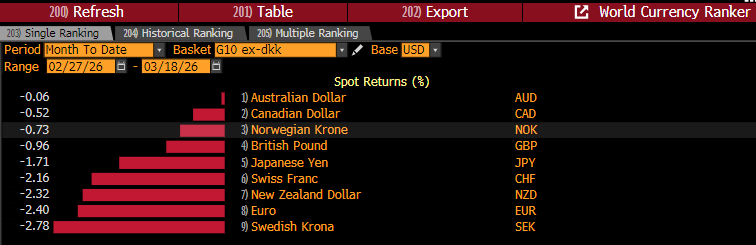
It's worth a reminder that the USD is a broad winner so far in March and through the Iran war!
Amid spiking oil prices, it's little wonder that the USD is an outsize winner given its net commodities/energy exporter and certainly some of the heaviest G10 losers are the big importers (SEK, EUR, YEN).
But, one relative outperformer is AUD still, which has just received a fresh semi prop from a second straight RBA (albeit a 5-4 vote).
So, it's worth keeping in mind, we also have the BOC, SNB, Riksbank, BOE, ECB and BOJ all to come this week (and Norges Bank next) and the USD could be at the mercy to an extent from external drivers and those central banks who take a more hawkish turn.
Other leading firms
It's also worth a quick look at the thoughts of other leading firms on the USD going into the FOMC announcement:
- BofA Global Research - Thanks to the US investor who remark Powell is set to adopt a 'wait & see' with the oil shock; SEP inflation and growth shift to lean hawkish but presser to sound more balanced. The meet is unlikely to be pivotal, USD upside risks will remain with oil focus. US rates have too much focus on inflation, too little focus on growth
- ANZ - Thanks to the Antipodean who describe themselves as neutral USD near term, with the FOMC meeting unlikely to drive a new direction. A likely unchanged verdict ahead, citing elevated uncertainty around the inflation outlook. Do not expect the decision to be unanimous, with doves citing monetary policy restriction is weighing on the labour market. Inflation expectations have stayed well-anchored through the early stages of the war, which provides encouragement the FOMC will be able to resume cutting interest rates around mid-2026. The Melbourne-based firm also points to the SEP updates, which likely acknowledge elevated uncertainties. ANZ do not expect it to fundamentally alter its outlook for the economy, labour market or inflation.
- ING - Interestingly, suggests the USD slip Tuesday was largely pre-FOMC position squaring rather than a signal of further optimism on geopolitics. Arare case of dislocation between oil prices and USD since the Iran conflict started, perhaps hinting that markets are – at least for this week – shifting their focus to the central bank reactions, also considering few signs of an imminent de-escalation. On the FOMC, the Dutch bank say risks are clearly of a hawkish revision in the Dot Plot projections, with the median currently signalling one rate cut by year-end. That matches current market pricing (-27BPsfor Dec), and the USD should benefit from a revision to no cuts in 2026. In terms of dovish risks, reintroducing “downside risks” mentioned in the statement’s section about jobs could help markets maintain expectations for a cut on a dual-mandate rationale. Expect no strong statements by Chair Powell on the inflation-growth implications from the conflict, which is still too volatile to venture into guidance in that sense. ING think rate expectations will remain fluid and tied to oil market swings even after this Fed meeting. So, ING expect a positive, but short-lived response by the USD, with geopolitical headlines quickly back in the driver’s seat
To receive this analysis plus much more, subscribe to IGM. Request your free trial of the service today.