

High-grade issuance once again failed to live up to expectations for the second straight week as borrowers navigated headlines out of Washington and a growing number of earnings blackout periods.
Just 10 issuers raised a combined $13.65bln across 19 tranches, falling short of even the $15bln low end of estimates and well below the $17.5bln average projection. That marks an even lighter showing than last week’s already subdued total.
As has been the trend, activity was front-loaded, with most borrowers choosing to capitalize on Monday’s relatively firm tone before uncertainty in Washington prompted a more cautious stance. Financials led the way from a sector standpoint, accounting for 59% of the week’s total. CRH America Finance Inc. opened the week with a $2.5bln three-part offering, while Yankee banks Toronto-Dominion Bank and Coöperatieve Rabobank added a combined $4.2bln. T-Mobile’s $2.8bln three-part deal stood out as the week’s largest corporate trade outside of FIG, helping industrials contribute 36% of overall volume. The bulk of issuance once again clustered in the 5- to 19-year tenor range.
Investor demand moderated further from September’s peaks but remained constructive overall. The week’s books were covered 3.07 times on average, while deals tightened by roughly 24.5bp from IPT to pricing and paid 2.71bp in new-issue concessions. Secondary performance softened to close the week, with recent prints trading on average 1.28bp wider, underscoring a more measured tone heading into the long weekend
That cautious tone extended to broader markets, where renewed policy uncertainty and light liquidity ahead of the holiday kept risk appetite muted. Sentiment was wobbly Friday, even before President Trump unexpectedly turned on China, threatening increased tariffs and saying the country was “becoming very hostile.”
Trump specifically described a ‘sinister move’ regarding restrictions on rare earth minerals. (Which incidentally helps explain why Treasury Secretary Bessent is actively supporting the Argentine economy and its abundant supply of rare earths)
Ugh. Half the Street was already in holiday weekend mode.
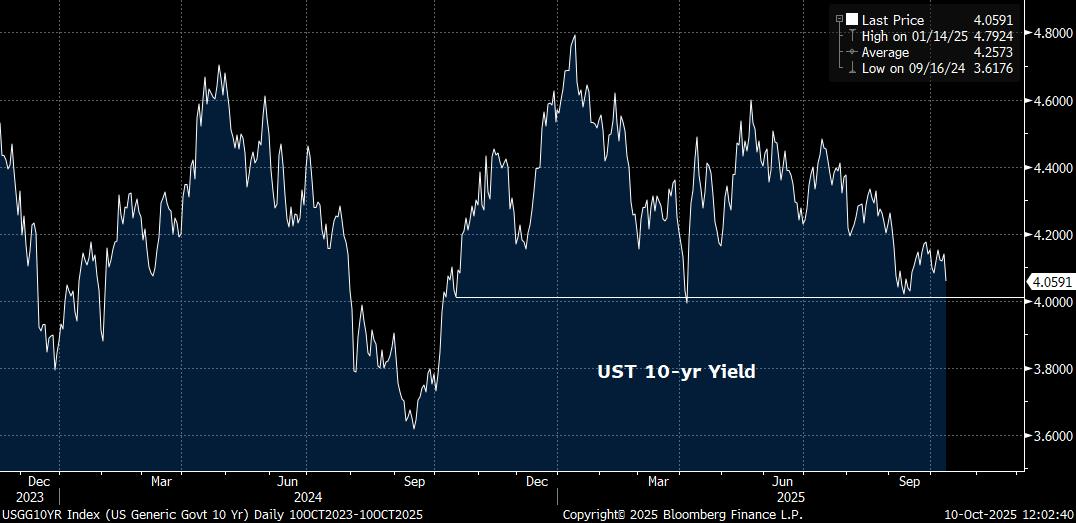
This gives traders another thing to worry about next week. Treasury yields extended an earlier decline, having previously shifted focus to who might not get paid next cycle and what lasting impact a prolonged government shutdown will have on the economy. The 10-year Treasury appears set for another look at 4%.
Tech led stocks lower as the semiconductor sector is sure to be on the front lines of the latest trade dispute, followed by regional lenders finding it hard to escape the fallout of the First Brands bankruptcy.
And in Washington, Office of Management and Budget Director Russ Vought dropped a departing gift on senators headed home for the long weekend, pronouncing that anticipated RIFs across agencies have begun.
The government, banks, and bond market will be closed Monday for the Columbus Day holiday, while equities remain open. Syndicate desks are calling for about $26bln in new issuance next week on average, with estimates ranging from $15bln to $30bln. The start of bank earnings season Tuesday should help reinvigorate activity in the high-grade primary market.
