

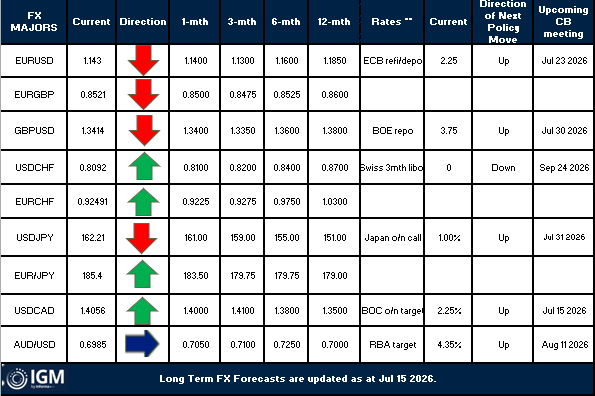
- Time to turn? We cannot describe ourselves as committed USD bulls and we do envisage a USD correction later in 2026, at some point, but this ongoing resilience has many of our estimates looking a real stretch.
- Last time out, in June 10's update, the USD was holding up well, having traded above the psychological 100.00 for the first time since April 7.
- In the interim, the DXY USD Index has hit a best since May 2025 of 101.80 and some of the other G10 majors have taken a dive.
- Markets continue to price a +25BPs Fed rate hike in Q3 even after some notable less than hawkish recent US events - a less hawkish view by Fed Chair at Sintra in early July (inflation risks have declined over the past four weeks) compared with his June FOMC comment (the Bank won't tolerate high inflation); material June NFPs misses (57k vs 113k estimate and revised softer 129k last) and Tuesday's softer than forecast US CPI for June report (3.5% y/y vs the 3.8% estimate and 45.2% last).
- Generally though, US data has been holding up through war and the exceptionalism prop continues to be touted.
- So much for US-Iran peace and a fresh escalation in violence has led to a correction in OIL from July 2 lows of Usd 70.14 brl to a 85.00-plus recapture this week.
- Elsewhere, the YEN cannot catch a break, staying in its lowly 160-163 range, despite a BOJ hike; an ongoing intervention threat and Japan Finance Minister Katayama's call for pension funds to invest in domestic assets.
- Another energy importer vs energy exporter, EUR/USD has made a big break below the psychological 1.1500 mark and subdued growth prospects and reduced international competitiveness looks to be weighing.
- GBP stays an outperformer as a short market has squeezed on UK PM in waiting Burnham talking a prudent fiscal stance though the possible choice of Miliband as Chancellor could be viewed more negatively as signs of that dreaded lurch to the left.
- Still, low hedge ratios on US assets arguably leave the USD vulnerable going into a potential impacter towards year-end and the November US mid-term elections and a possible backlash towards Trump.
EUR/USD - The lower tops continue unabated, latterly at 1.1622 (perhaps even 1.1473!).
Those 1.20-plus calls for 2026 have faded away as all things US on a perceived more hawkish Fed outlook; reduced concerns (for now) over the future of Fed independence; the intermittent Trump tariffs threat and war support the broad USD. This battle between energy importer vs energy exporter has led to near one-way trade since mid-April as EUR/USD falls below the psychological 1.1500 and subdued growth prospects, reduced international competitiveness also look to be weighing. Even potential more ECB tightening and a big German reform package are unable to stoke demand for EUR-denominated assets at this juncture.
- Forced to move lower across the period. We are hearing of a pick-up in a further decline to 1.10 calls (actually puts!!), but we think approximate 1.1250 could be a floor for 2026.
USD/YEN - The JPY just cannot catch a break, staying in its lowly 160-163 range, despite a BOJ hike; an ongoing intervention threat and Japan Finance Minister Katayama's call for pension funds to invest in domestic assets.
The US-Japan short-term rates spread has continued higher and only a far more dovish Fed and/or a more aggressive BOJ in hiking mode looks capable of sparking a natural turnaround. Yes, the intervention threat remains, perhaps as soon as the next Tokyo markets holiday period (June 16-20). Still, we cannot see much topside beyond 164-165 for now.
- Again, reluctantly, we need to nudge estimates higher even though conviction for this sort of strength in the medium-term is currently lacking.
GBP/USD - A relative outperformer between the two latest reports.
A short market has squeezed on UK PM in waiting Burnham talking a prudent fiscal stance though the possible choice of Miliband as Chancellor could be viewed more negatively as signs of that dreaded lurch to the left. This market continues to see-saw over expectations for one +25BPs rate hike from the BOE in 2026 and we continue to monitor developments, staying data dependent (albeit with some hawkish scepticism still).
- Estimates a touch lower. We continue to monitor sentiment. If it improves then those big shorts (-87903 on IMM) could get pared meaningfully and lead to further GBP upside through Q3, beyond 0.8500, 1.3500.
USD/CHF - A beneficiary of the unwinding of the USD debasement trade and a 0.8000-plus return. Also, in the interim, we learned SNB purchased Chf 3.9bln of FX in Q1. Yield differentials mean EUR/CHF has moved well beyond the psychological (and line in the sand?) 0.90 though higher energy prices are a natural weight. However, given the intermittent risk averse backdrop of geopolitics and ongoing war, growth concerns, politics and the November mid-terms et al we see only limited downside potential for the haven Franc.
- Higher to reflect the 0.80-plus move, but we see only limited further Franc downside at this juncture.
USD/CAD - Today, the BOC is widely expected to remain on hold at 2.25%, but there looks to be risk of a more hawkish signal on above target headline inflation (on higher food, energy prices). Pre-verdict, a +25BPs BOC hike in 2026 is not quite fully priced. So, yield differentials continue to support Funds above 1.4000, but at least there has been a modest improvement in Canada activity and labour market data. On July 1, the US announced it would not renew the USMCA free trade deal in its current form. It will now be reviewed annually until 2036 and looks an intermittent Loonie weight as the relationship between the two leaders, Carney and Trump, seemingly remains less than warm.
- Estimates raised to acknowledge 1.4000-plus move.
AUD/USD - The H1 big outperformer has been giving back ground, plenty of it, after peaking at 0.7278 in May and following the last of the three straight RBA hikes to 4.35%. Yield differentials have been on the turn as many market participants bet on a lid in Australia rates for now (2026). Other less than supportive factors include softer energy and hard commodity exports prices; a weaker local housing market and tax implications from the Federal Budget. Still, Australia/RBA is G10 carry king and Aussie perhaps significantly holds above its 200-dma still, at 0.6880 last.
