

December historically marks the USD's weakest month with an average -0.9% decline since 2000, though 2024's broad USD strength against all G10 currencies raises questions about whether seasonal patterns will hold amid shifting Fed expectations and Trump administration policies.
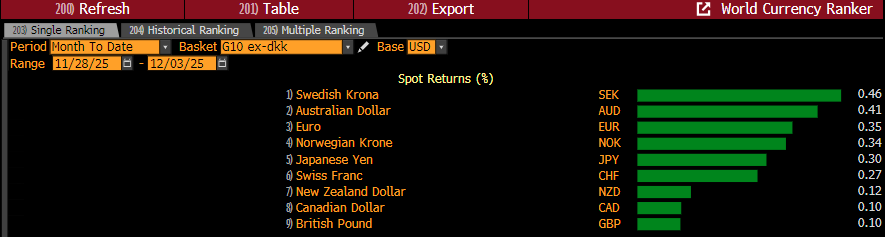
 See image above. The USD is broadly a touch softer in the month's early exchanges, most acutely vs -0.4% EUR and AUD and -0.5% SEK, as our suspicion that December could turn out to be a pullback, even corrective month shows tentative signs of panning out. Also, there is growing belief that current Director of the NEC Hassett is favoured as Trump's pick for next Fed chair. Hassett's views are seen as most closely aligned with the president so more dovish!!
But, as ever from a seasonality perspective, the question is how does the USD tend to fare generally in the run-up to year-end? Further, are there any G10s that seem to perform particularly well/badly through the month of December?
 See above. In December 2024, the USD was a material winner across the board, from +3.0% GBP through to +4.9% EUR, +6.0% AUD and +6.4% NZD. Was this just an outlier given the Fed's less dovish repricing, Trump's win and potentially reflationary and pro-growth policies and ongoing US exceptionalism?

- See above. In 2023, the USD lost out across the board, from -0.9% GBP through to -5.1% YEN and -6.3% NOK.
- In 2022, the USD was mostly a loser, most acutely against -2.3% CHF, -2.9% EUR and -5.3% YEN. Sole USD win came against +1.1% CAD.
- In 2021, a similar story of mostly USD losses, with biggest downside came against -1.8% GBP, -1.9% AUD and -2.5% NOK. Only USD wins came against +0.3% SEK and +1.7% YEN.

- See above, in 2020, the USD was a loser across the board, from -1.0% YEN through to -3.5% NOK, -4.2% SEK and -4.8% AUD.
- In 2019, same again, full USD losses. This time, from -0.8% YEN (again) through to -3.5% CHF, -3.8% AUD and -5.0% NZD and NOK.
- 2018 was more mixed. Material USD losses seen vs -1.6% CHF, -2.9% SEK and -3.5% YEN. Biggest USD wins against +2.2% NZD, +2.5% CAD and +3.5% AUD.
- In 2017, the USD was a near broad loser, down -0.9% EUR to the likes of -2.4% SEK, -2.6% CAD, -3.2% AUD and -3.9% NZD. The USD only won and tiny vs +0.1% GBP and JPY.
- In 2016, all change and only USD losses were vs -1.4% SEK, with decent USD upside seen vs +1.3% GBP and NOK, +2.1% NZD and JPY and +2.4% AUD.
- In 2015, it was a mixed affair. The USD was lower vs the likes of-0.8% AUD, -2.8% EUR and -3.8% NZD. The USD was up +1.6% NOK, +2.1% GBP and +3.5% CAD.
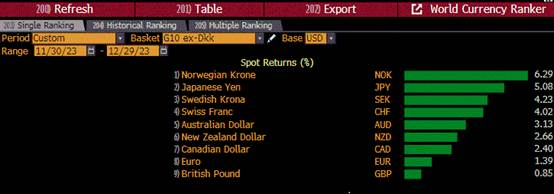
- See above, in Dec 2014, the USD closed the year stronger across the board, from +0.4% GBP to +5.7% NOK.
- In 2013, the USD was a wide loser, from -0.9% NOK to -1.5% CHF and -1.7% SEK. The USD was only up vs the +2.1% AUD and +2.7% JPY.
- In 2012, it was a very similar story, mostly Usd losses again, ie from -0.2% CAD through to -2.0% NOK and -2.4% SEK. The USD only won out vs +0.3% AUD and +4.9% the Abe impacted YEN.
- In 2011, light USD losses only vs -0.9% YEN and USD gains everywhere else in G10 land, incl +2.7% CHF, +3.4% NOK and +3.6% EUR.
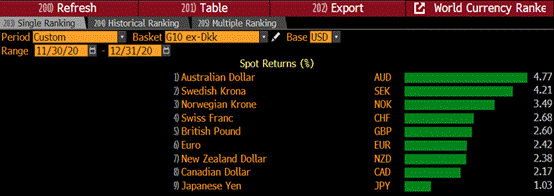
- See above, in 2010, the USD was a loser across the board, from -0.3% GBP to big losses versus -4.7% SEK, -5.1% NZD, -6.7% NOK and AUD and -7.3% CHF.
- In 2009, the USD only lost out vs -0.3% CAD and -1.0% NZD. USD gains elsewhere and big ones incl +2.9% CHF, +4.6% EUR and +7.1% JPY.
- In 2008, as the GFC was taking its toll, there was mega movement and the USD was mostly softer, incl -5.4/5% JPY and NZD, -7.2% AUD, -10.1% EUR and -13.6% the chief safe haven CHF. Sole USD win came against the +5.6% GBP.
- In 2007, only significant downside was made vs -2.0% NOK and largely light gains elsewhere, the +3.5% GBP the highlight.
- In 2006, similarly, sole USD loss was -2.9% NZD. Elsewhere, the USD was a winner, with the +1.8% CHF, +2.2% CAD and +2.7% YEN the highlights.
- In 2005, more of a mixed bag. Main USD losses came against -1.8% YEN and SEK, with most acute USD gains being +0.7% AUD and +2.7% NZD.
- In 2004, mainly USD losses, most acute being -1.1% SEK and -2.1% EUR. Only USD victory was +1.2% CAD.
- In 2003, the USD was flogged across the board, with biggest losses coming against -4.2% CHF and -5.0% SEK and EUR.
- In 2002, mostly USD losses, largest being -5.5% EUR, -5.6% NOK and -7.2% CHF. Sole USD win came against +0.4% CAD.
- In 2001, USD losses came against -1.6% SEK and -2.1% GBP. Everywhere else in G10 land was a USD win, most acutely +2.4% AUD and +6.2% YEN.
- For good measure, in 2000, big moves and largely USD downside, from -2.5% CAD through to -7.3% CHF, -7.7% NZD and -8.0% EUR.
See table above, since 2000 December is clearly the Dollar's worst performing month of the year in terms of DXY USD Index. The DXY has dropped on average -0.9% p/m in Decembers during the period, with seven of the last eight years all coming in negative. Positive risk sentiment amid historic strength in equities tends to be a main (negative) driver here.
Something new for 2025, see table below - The USD's performance on average vs each G10 since 2000 in Decembers.
| AUD/USD | USD/CAD | USD/CHF | EUR/USD | GBP/USD | USD/NOK | NZD/USD | USD/SEK | USD/YEN |
| +0.8% | Flat | -1.7% | +1.4% | +0.3% | -0.9% | +1.5% | -1.6% | +0.2% |
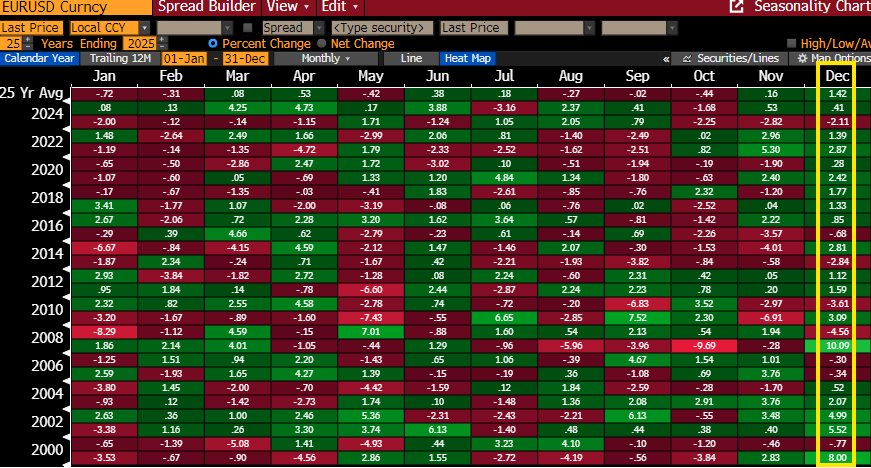
See next table, EUR/USD has gained on ave +1.4% p/m during the period, with a notable positive trend too.
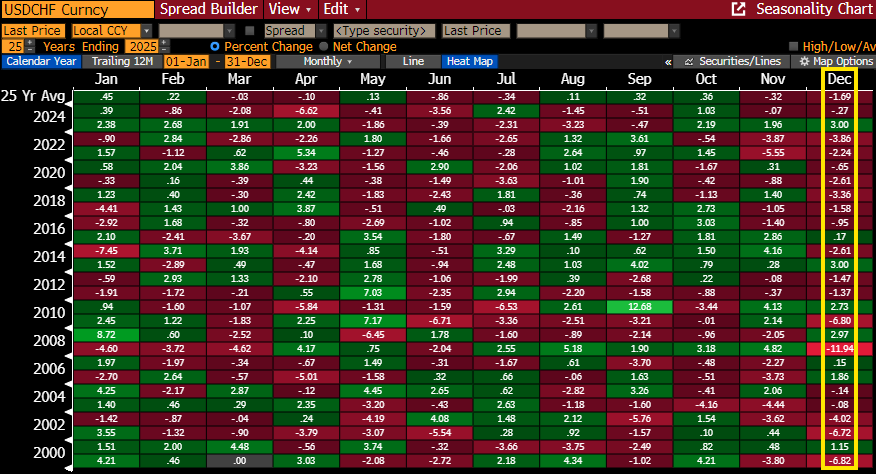
See above. USD/CHF is historically an outsize loser in Decembers. Historically, on average, USD/CHF loses -1.7% p/m during Decembers through to 2000, with the previous seven out of eight years negative too.
 See table above. And, finally, NZD/USD tends To be an outsize winner, up +1.5% p/m during the period.