Posted by IMN on 21 August 2026
The mid-year banking outlook: Risks rising & opportunities emerging

Credit problems used to arrive slowly. Now they show up overnight. That theme held this year’s mid‑year banking outlook at IMN’s Bankers Special Assets West, 2026. A panel where every speaker, regardless of portfolio type or institution size, described the same unsettling pattern: the issues emerging in 2026 aren’t behaving the way they used to.
Some loans deteriorate exactly as expected in a high‑rate environment. Others collapse out of nowhere. Certain borrowers are holding on longer than models predicted. Others are cracking despite strong historical performance. And across consumer, Commercial Real Estate (CRE), Commercial & Industrial (C&I), and private credit, the timing and severity of stress are becoming harder to map.
This session had one clear focus: to break that pattern, and to unpack what those broken patterns meant for the second half of the year.
The economy isn’t crashing; It’s warping in ways that matter for credit
Haley Leek, Associate Director, Data Research at Trimont, opened with a macro-overview that immediately reframed the room’s expectations. The labor market is still “stable… declared steady”, but labor force participation has quietly slipped to its lowest point since 2021. A surprising share of prime‑aged men are “choosing to stay home and allegedly play video games”. This highlighted something more powerful: a sign of behavioral shifts that don’t show up neatly in headline data.
Consumer stress is building. Credit card delinquencies have “spiked… above 13%”, approaching Global Financial Crisis (GFC) territory. Auto delinquencies are rising. Buy now, pay later usage is surging. All while inflation remains elevated, driven heavily by energy — “60% of the increase in Consumer Price Index (CPI) is actually energy‑driven”. Rising fuel costs ripple through trucking, logistics, food, fertilizer, and ultimately CRE operating expenses.
And yet, the Federal Reserve recently described economic activity as solid.
For special assets teams, the message was clear: the macro picture isn’t deteriorating. It’s becoming uneven, and uneven markets create both opportunity and exposure.
Higher‑for‑longer has become a behavioural shift, not a forecast
One of the strongest themes delved into how higher‑for‑longer has changed behavior inside banks. One speaker on the panel put it plainly: “The interest rate environment has decimated balance sheets… liquidity is always king.” Borrowers have stopped waiting for rate relief. Lenders have stopped pretending it’s around the corner.
Another speaker noted that higher‑for‑longer “challenges the idea that we can wait for rates to be more favorable”. This isn’t just a rate story; it’s a timing story. The pause button is gone. Decisions that were delayed in 2023–2024 are now unavoidable.
For distressed teams, this means more files moving, more conversations happening earlier, and more borrowers willing to restructure before things break.
Capitulation is quietly increasing, and it’s changing the market
“We are seeing an increase of activity… about half a billion in the market right now,” as reinforced by one speaker on the panel. That line landed exactly how it should have. Why? Because it finally confirmed what many in the room suspected: the freeze is thawing.
After the Silicon Valley Bank (SVB) collapse, banks were hesitant to take losses, not because the losses weren’t real, but because the optics were painful. Now, the market is rewarding institutions that clean up their balance sheets. That shift alone is enough to change behaviour.
The result?
- More assets quietly coming to market
- More willingness to recognise impairments
- More special assets activity expected in Q3 and Q4
This isn’t a wave of distress; it’s a wave of reality.
CRE risk isn’t a single story; it’s a patchwork
The panel pushed back on the idea that “CRE is struggling.” It’s not wrong, it’s just incomplete.
Different sectors are telling different stories:
- Office is still challenged, though NYC leasing activity is improving (as 2026 pushes through as the “best year since 2000” for new leases)
- Industrial continues to outperform
- Retail is stable
- Hospitality is improving
- Multifamily is stable but squeezed by rising operating costs
The real issue isn’t the asset class, it’s the capital stack. Deals built on aggressive assumptions or high leverage are showing the most stress. For special assets teams, this reinforced a familiar truth: distress is rarely about the building; it’s about the structure.
Regulators are paying more attention, but not in the way headlines suggest
Oversight is tightening, especially around private credit exposures. Regulators are conducting horizontal reviews to understand structures, nomenclature, and risk transmission.
While there isn’t an expectation of major intervention unless consumer credit deteriorates significantly, a potential Federal Reserve leadership change was raised as a concern. However, common ground was found that the policy direction is unlikely to swing dramatically. For attendees, this was grounding: regulatory pressure is rising, but not in a way that should trigger panic.
Private credit: A safety valve, a risk factor, and a wild card
Private credit generated some of the most animated discussion, and some of the most memorable lines.
The concerns were clear:
- Many private credit loans aren’t impaired the way regulated banks impair assets
- Payment‑in‑Kind (PIK) interest structures mask underlying weakness
- Workout timelines are unrealistic
- Collateral quality varies dramatically
And yet, private credit remains essential. If it retreats, banks lose a critical release valve. For special assets teams, the takeaway was pragmatic: private credit is neither hero nor villain! It’s a force you need to understand.
Is construction lending dead?
Construction financing is still happening, but only where fundamentals justify it.
The panel highlighted three areas that continue to make sense:
- Housing formats with consistent demand
- Industrial in supply‑constrained markets
- Hospitality repositionings led by experienced operators
As one speaker joked: “We’re not allergic to construction. We’re just reading the fine print twice.” This wasn’t a surprise, but it was a useful recalibration. Construction lending hasn’t disappeared. It’s just grown up.
Regional bank stability
Widespread failures aren’t expected, but certain regional institutions may face pressure due to legacy portfolios or concentration risk. This is creating quiet interest in Mergers & Acquisitions (M&A), especially among banks looking to strengthen balance sheets or expand footprints. Large national banks benefit from diversified revenue streams. Smaller banks lean on relationship lending and specialized expertise.
The takeaway? Stability exists, but it’s not evenly distributed.
Is recession more nuanced than headlines suggest?
Speakers were split on recession risk. Some see resilience; others are watching consumer credit closely. Rising fuel costs, supply chain pressures, and operating expenses remain concerns. But higher‑for‑longer is also forcing necessary adjustments, challenging “extend and pretend” and pushing valuations toward realism.
The shared view: the next six months will require attention, but also, as a consequence, present meaningful opportunities for disciplined lenders and investors.
The real story: A market repricing, not retreating
The mid‑year outlook revealed a market that is adjusting, not collapsing. Banks are becoming more selective. Borrowers are recalibrating. Regulators are watching. Private credit is both a support and a risk. And opportunities are emerging for institutions that stay focused on fundamentals.
For attendees, the value of this session was simple: a realistic, operator‑level understanding of where the market truly stands, and where it’s heading next.
Continue the conversation
If you want to stay ahead of the discussions shaping distressed real estate, special assets, and bank credit, join us at IMN’s upcoming events:
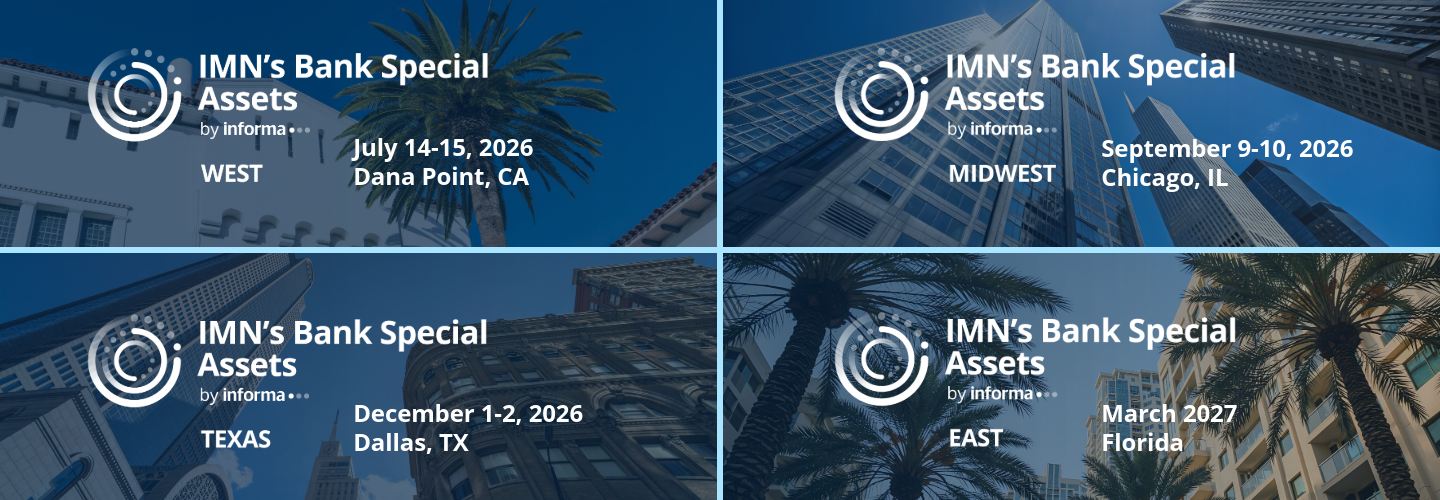
Bank Special Assets Midwest | September 9–10, 2026 | Chicago, IL
Distressed CRE East |October 14, 2026 | New York, NY
CRE CLOs | November 3, 2026 | New York, NY
Bank Special Assets Texas | December 1-2, 2026 | Dallas, TX
Bank Special Assets East | February 2-3, 2027 | Miami, FL
Bank Special Assets West | July 14-15, 2027 | Dana Point, CA
These forums bring together the operators, lenders, credit officers, and special assets teams who are navigating these challenges in real time and shaping where the industry goes next.