What Does Your Innovation Pipeline Look Like?
Chances are your innovation pipeline diagram looks like one of three things: An Innovation Funnel, a Lifecycle Chart, or anything drawn with a PowerPoint SmartArt Graphic.
The most common innovation pipeline shape appears to be the horizontal 'Innovation Funnel' or stage-gate process. Ideas are represented by freely floating 'soap bubbles,' loads of them. These ideas are harnessed and stuffed into the wide end of the funnel so that they can be shaped into concepts. The concepts are then evaluated against corporate-specific criteria, and those that pass evaluation are moved along the pipeline to product/service planning, then development, then test, then launch.
There are advantages to this model. It acknowledges that there are many potential ideas out there, but that only a subset can be worked on. It provides a mechanism to allocate limited resources for further research and development. It helps you visually depict your innovation portfolio. But is this the way innovation really happens? Here are some challenges to the Innovation Funnel:
1) The funnel assumes that ideation happens at the beginning of the process, whereas there very well may be ideation anywhere along the pipeline, especially as a result of a snafu. Sometimes one of the abandoned soap bubbles can be combined with a developing concept to make it viable or stronger.
2) You may have a false sense that you can predict success, that what gets launched at the end will, indeed, deliver the outcome you had projected because you're following a methodical process.
3) While you are in process, the world is changing in any number of ways that may cause you to re-evaluate your approach or even your whole program. For example,
' An enabling technology becomes available
' The economy shifts
' A trend takes hold
' Your company gets acquired, divided, merged'or has new leadership
' A serendipitous something happens that turns your assumptions on their heads.
An emerging alternative is Agile Innovation, or Lean Innovation. In agile innovation, you iteratively design, build, measure with customers and end users. An agile innovation process allows for 'pivoting,' that is, changing direction based on what you have discovered at each iteration. You can't go too far down the path without discovering that you've hit a snag. And you have data to present to stakeholders that demonstrates your learning. This is, in my opinion, the best way to manage innovation. But is this the way innovation really happens?
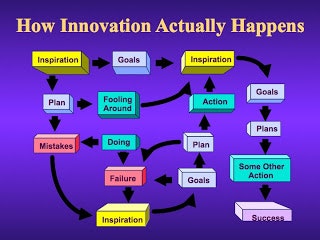
Here's an interesting diagram, posted by the Future of Flight Foundation, a nonprofit organization in Washington State whose mission is 'to be the leading center of learning and innovation for science, technology and aviation.' They credit Pinchot & Company of Bainbridge Island, Washington. (Pinchot & Company is owned by Gifford Pinchot III, who coined the term 'Intrapreneur' back in 1978.)
