

LSX Congress USA Investor Spotlight
LSX Congress USA 2026 has, so far, seen more than 2000 1:1 partnering meetings scheduled with 300+ investors present. For start-ups and innovators, partnering events like LSX Congress USA present a great opportunity to meet with potential investors, showcase your science and your founder story, and start building connections and trust.
The Investor Spotlight series introduces you to some of our investors, their thoughts on investment gaps, and the criteria they use to evaluate start-ups. Discover what investors are looking for and leverage their advice to make your first meetings land even better.
If you are looking to prepare for your time at LSX Congress USA, you can also check out our Taking the Pulse series which covers advice from pharma leaders.

Boston Harbour Angels
What stage of company development represents your sweet spot right now? Why?
As angel investors, we like to come in early – we are the round that comes after friends and family and before VCs. However, recently the landscape has merged with VCs starting earlier, angels raising more money, and family offices entering the angel space.
While we prefer to invest early, an unwritten ethos we follow is that we need a great founder and a solid structure.
Boston Harbour Angels shares...
Where do you see an unmet need or investment gap in the biotech sector?
We’d love to see more of the intersection of industries in life sciences – for example, how medical devices, AI, biotech, and IT can work together to deliver better patient care and make people’s lives easier overall. Another interesting avenue can be wellness and AI.
Additionally, deals that are mixed between industries do not need as much funding and can get to revenue quicker than drug discovery ones.
What are the top three criteria you evaluate when meeting a biotech company for the first time at an event like LSX Congress USA?
We have developed an acronym to describe what a great founder is – the 7 Hs:
Humble
Honest
Hard-working
Hungry for work
Humour
Humanity
Hurry
If you could give one piece of advice to companies hoping to secure a meeting with you at LSX Congress USA, what would it be?
The shortest distance between an investor and a founder is a story. Especially for angel investors who may not be very deep into the science, we need a good story.
Secondly, I call it – investor empathy. Investors see a lot of deals and that means you need to be patient with us, deals don’t happen over one conversation. If you come to an investor, as a founder, and make it clear you don’t like fundraising – that’s a red flag for us. Lead with a good story but also showcase how you can create value for investors and try to understand their perspective and lived experiences too. If you don’t know or understand your investor audience, then learn about them – attend meetings, go to conferences such as LSX Congress USA, listen, watch and absorb the knowledge of others.

Chiesi Global Rare Diseases
Are there any biotech subsectors you are most excited for in 2026 and beyond?
I'm particularly excited by technologies that increase the breadth and accessibility of genetic medicines. Gene editing continues to be a major area of interest, but the real breakthroughs may come from advances in delivery, including non-viral systems, extra-hepatic targeting approaches, and technologies that enable repeat dosing.
I'm also closely watching in utero therapeutics. As our understanding of disease biology improves, there is an opportunity to intervene before irreversible damage occurs, potentially transforming outcomes for patients with severe genetic diseases.
Finally, while I don't actively scout AI companies, I believe AI will increasingly become part of the scientific infrastructure that accelerates target discovery, patient identification, and drug development, rather than a standalone sector.
Ultimately, what excites me most are technologies that can help bring advanced therapies to more patients across more diseases, particularly in rare diseases where unmet need remains incredibly high.
Chiesi Global Rare Diseases shares...
Where do you see an unmet need or investment gap in the biotech sector?
One of the largest gaps remains translational funding for highly innovative early-stage rare disease companies. The science is often compelling, but many programs struggle to secure the capital, development infrastructure, and strategic support needed to generate the data required for larger investments or partnerships.
In rare diseases, the challenge is increasingly not whether the science can work, but whether sustainable development and commercialization models exist to bring those innovations to patients. We need more mechanisms that bridge the gap between academic discovery and investable companies, particularly in platform technologies that have the potential to impact multiple indications.
What are the top three criteria you evaluate when meeting a biotech company for the first time at an event like LSX Congress USA?
As a scientist, the science always comes first. How compelling are the data, particularly in terms of safety and efficacy? Does the technology address a meaningful unmet need?
Second, differentiation. Does the technology bring a novel approach that could meaningfully improve the patient journey and address challenges that remain unmet today?
Third, the team and its ability to execute. Compelling science is essential, but it rarely translates into impact without the right team behind it. You can often get an early sense of that from how the team communicates, how deeply they understand the challenges ahead, and how thoughtfully they respond to difficult questions.
If you could give one piece of advice to companies hoping to secure a meeting with you at LSX Congress USA, what would it be?
Be clear about the problem you are solving and why your approach is uniquely positioned to solve it. The strongest companies can explain their value proposition in a few minutes while demonstrating a deep understanding of both the science and the path to patients.

Melior Capital Management
If you could give one piece of advice to companies hoping to secure a meeting with you at LSX Congress USA, what would it be?
Know what you want to do with the funds that we will deliver.
Melior Capital Management shares...
Are there any biotech subsectors you are most excited for in 2026 and beyond?
Cancer: Blood-based tests to detect a broad cross-section of cancers. Improved efficiency to detect cancer during biopsy to enable faster transition to personalized cancer therapy.
Heart Disease: Improved ways to treat atrial fibrillation and value function. Use of robotics and AI.
What are the top three criteria you evaluate when meeting a biotech company for the first time at an event like LSX Congress USA?
Management track record, sound business plan, and realistic regulatory plan.
The team needs the skills to morph from pre-clinical to clinical to commercialization.

Pacific Bridge NY
What stage of company development represents your sweet spot right now? Why?
There isn’t a single stage that defines our sweet spot. For east-to-west opportunities, we want to enter early enough to influence development strategy and capture the value created by successfully globalizing the asset. For west-to-east investments, we generally look later, once clinical validation has begun but before the major value-inflection points have occurred. That allows us to deploy both capital and our cross-border capabilities where we think they can have the greatest impact.
Pacific Bridge NY shares...
Are there any biotech subsectors you are most excited for in 2026 and beyond?
We continue to be particularly interested in oncology, immunology and inflammation, nephrology, neurology, and neuroinflammation. But within those areas, differentiation matters more to us than simply investing behind a popular therapeutic theme. We’re looking for assets with compelling biology and a credible path to demonstrating meaningful clinical benefit, particularly where we believe a cross-border development strategy can unlock additional value.
Where do you see an unmet need or investment gap in the biotech sector?
We think the cross-border development gap remains underappreciated. Strong assets do not always originate in the geography best positioned to finance or develop them. The opportunity is not simply to provide capital, but to combine capital with the right clinical-development ecosystem. Sometimes that means bringing an Asian asset into a U.S. NewCo and building a global strategy around it; in other cases, it means helping a Western company use the China ecosystem to accelerate clinical development.
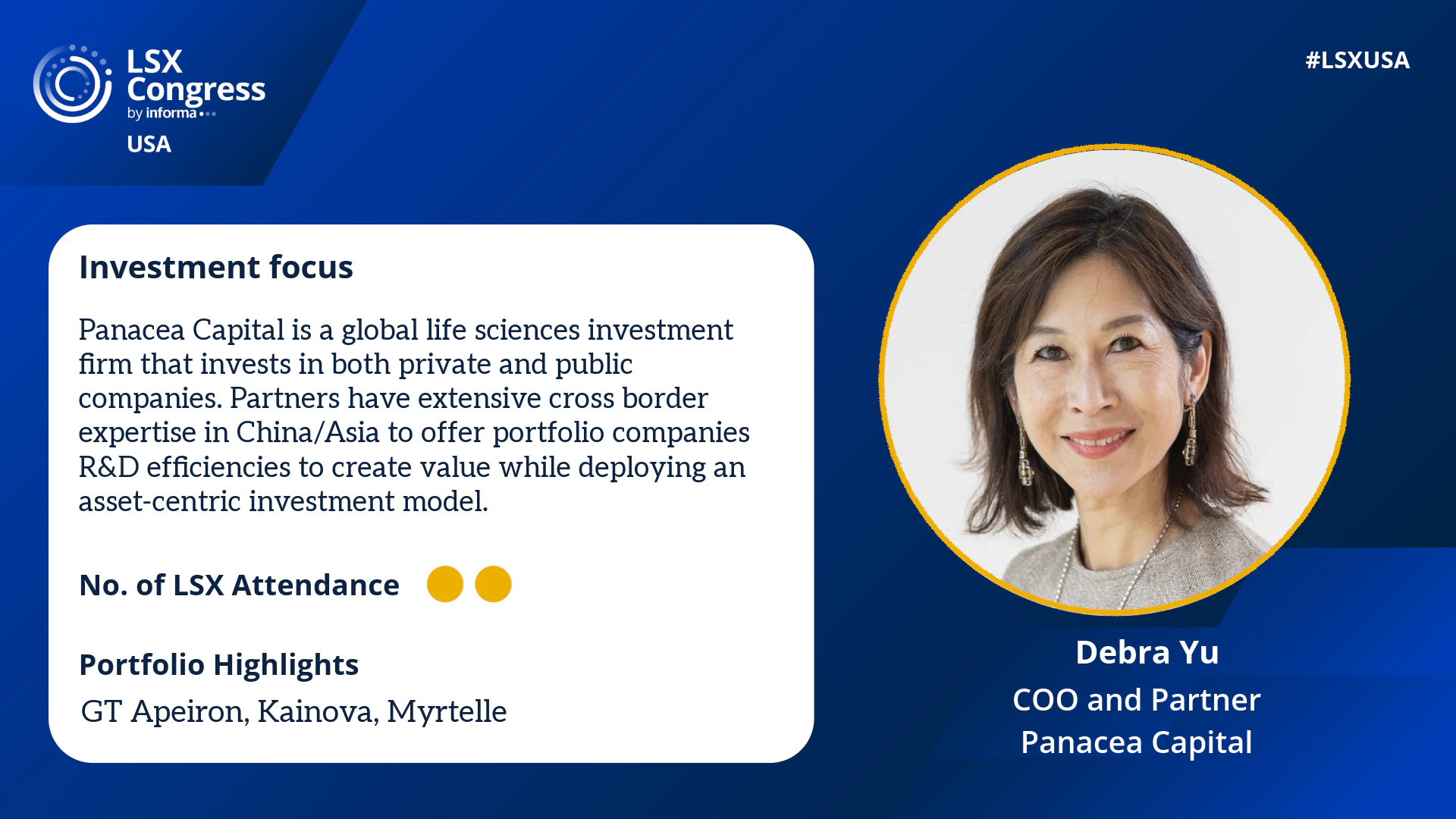
Panacea Capital
If you could give one piece of advice to companies hoping to secure a meeting with you at LSX Congress USA, what would it be?
Produce a well-articulated summary that highlights specifically what is the use of funds and the next milestone(s) and how the program or initiative plays in the competitive landscape with a focus on what is the specific differentiation
Panacea Capital shares...
Are there any biotech subsectors you are most excited for in 2026 and beyond?
We are TA agnostic and are highly interested in technologies that can help create next gen assets.
Where do you see an unmet need or investment gap in the biotech sector?
Two gaps stand out to us. The first is a real, comprehensive understanding of China and the broader Asia ecosystem — specifically how SMID-cap companies and Western investors can leverage Asia for development advantages, whether it is speed and cost, access to high-quality assets through in-licensing or leveraging the wealth of engineering talent to create new assets. Most of the market still treats this as a passing headline rather than a repeatable strategy, and the investors who develop genuine fluency here will have a durable edge. The second is a growing compression at the early stage: as capital concentrates in a smaller number of mega-funds writing large checks into large rounds, the smaller, earlier companies — often the ones doing the most differentiated science — are increasingly underserved. How to fund those companies, and who steps in to do it, is a real and widening gap, and it's part of why we've leaned into strategies that let us go earlier and back them deliberately.
What stage of company development represents your sweet spot right now? Why?
We operate across the lifecycle through complementary and synergistic strategies. On our core venture strategy side where we have done a lot of company formation which includes early stage but also creating companies out of new assets and the application of platforms to new product development. Alongside that, we run a smaller public investment strategy focused on identifying undervalued NASDAQ-listed biotechs where we can take an active, hands-on role — reshaping strategy, capital allocation, and often the team to transform the company from the inside, mimicking our private strategy but with biotech that have a NASDAQ ticker. And we've been building newer initiatives that let us go even earlier, into true white-space opportunities where we help form the platform around a novel insight with potential partners aligned from day one. The common thread across all three is the same: differentiated science, a clear path to a value-inflecting milestone, and a place where our active involvement genuinely changes the outcome — the stage just changes with the vehicle.
How have current market challenges influenced your investment decisions?
A tighter capital environment has made us more disciplined about capital efficiency and proof points. We now underwrite every company to a specific, near-term data event and ask whether the money in the round actually gets them there with margin to spare, and we've raised the bar on syndicate quality — we want co-investors who will show up in the follow-on, not just the first round. Lastly, we have a greater focus on investing with an eye toward what the ultimate buyer wants, and incorporating these players from the start.
What are the top three criteria you evaluate when meeting a biotech company for the first time at an event like LSX Congress USA?
First, how clearly they articulate what they do and where it sits in the landscape — can they explain the science crisply, show they understand the competitive field, and point to a real biological insight with a defensible reason it hasn't been done before? A team that can't frame its own differentiation in a first meeting usually hasn't fully worked it out. Second, the path to a value-inflecting data point — how quickly, and with how much capital, can they generate a result that de-risks the thesis? Third, the management team — the depth of their experience, the judgment to kill their own ideas, the credibility to attract talent and capital, and the coachability to take input. If those three line up, most of the rest is solvable.
quadraScope Capital
How have current market challenges influenced your investment decisions?
It’s been challenging to raise a biotech focused fund in the current market. We favor later stage companies that have a shorter time to exit, thus returning on our LP investments sooner and helping to grow the fund so we can funnel more money to companies that can reverse biological aging.

quadraScope Capital shares...
Are there any biotech subsectors you are most excited for in 2026 and beyond?
Immunotherapy, gene therapy, cell therapy, personalized medicine, AI/robotic drug development
Where do you see an unmet need or investment gap in the biotech sector?
Longevity biotech – treating the hallmarks of aging to cure or prevent diseases
What are the top three criteria you evaluate when meeting a biotech company for the first time at an event like LSX Congress USA?
Scientific foundation, stage of development and industry partnerships
Beyond science and financial data, what intangible qualities are you looking for in a founding team?
Appreciation of how challenging it is to succeed with a startup, responsiveness, Boston location is a plus