

The Technology Stage at Greenbuild
The Technology Stage is located in the expo hall. It will feature the latest in green building technology with a deep dive into how it works and how it can accelerate your sustainability projects.
Sponsored by Autodesk
Source sustainable products & services
See the latest technology and experience it first hand how it transforms workflows, accelerates performance, reduces costs, and advances sustainability.
From smart systems to digital design platforms, this is where ideas become reality.
To attend the Technology Stage sessions, an Expo Hall pass is required.
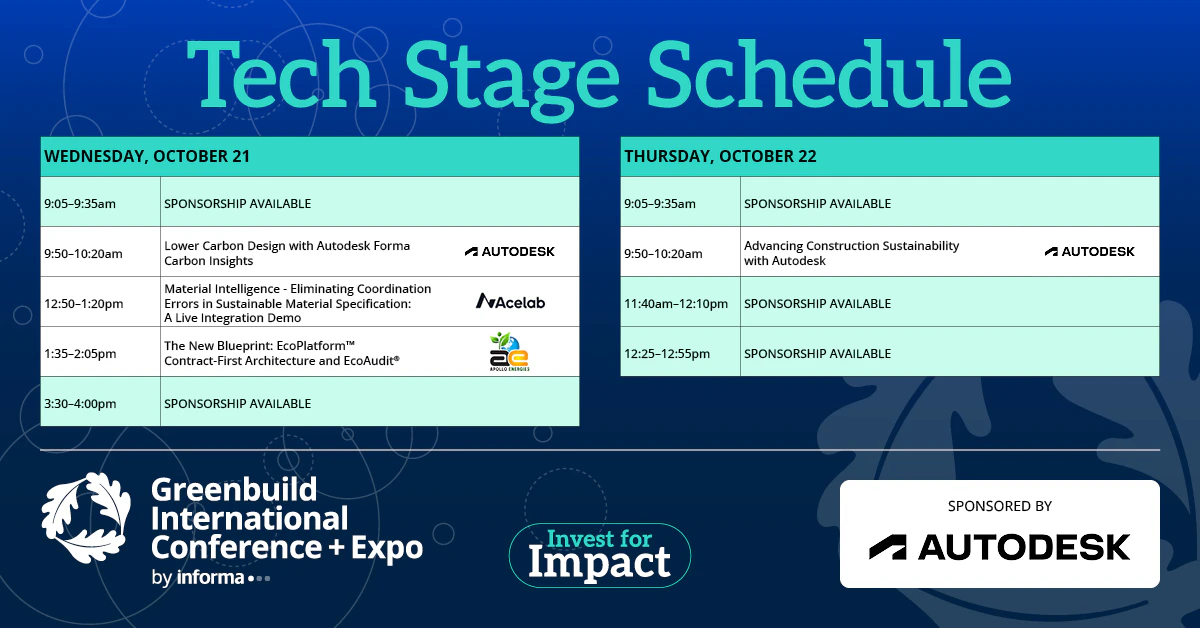
Sessions on Wednesday, October 21
9:50-10:20am ET
Autodesk Presents: Lower Carbon Design with Autodesk Forma Carbon Insights
Sustainable design depends on understanding carbon impacts early. See how Autodesk Forma Carbon Insights brings embodied and operational carbon assessment directly into Forma Building Design, Forma Site Design, and Revit, helping project teams evaluate design decisions, support sustainability goals, and generate transparent, customizable reporting within their existing workflows.
Speaker: Indigo Adara, Industry Impact Content Enablement Lead, Autodesk
10:35-11:05am ET
Applied Photonix Presents: Plasmonic Photonics and Next-Gen Air Disinfection
Dr. Yogi Goswami, Distinguished University Professor at the University of South Florida and the Director of the Clean Energy Research Center, will be presenting the science behind his third generation, indoor air disinfection technology. The ViroZap® in-duct, air disinfection platform is the first FDA-cleared, Class II Medical Device for whole building air disinfection.
11:20-11:50am ET
Structured AI Presents: Catch More Errors in 30 Minutes Than a Week of Manual Review
Structured AI is the most advanced AI-powered QA/QC platform for drawing packages, across PDFs, Revit, and Civil 3D. Our agents learn your standards, apply codes, and flag what's wrong, where, and how to fix it. See how multidisciplinary firms improve drawing quality, catch 10x more errors, and cut RFIs.
12:50-1:20pm ET
Acelab Presents: Material Intelligence - Eliminating Coordination Errors in Sustainable Material Specification: A Live Integration Demo
When drawings, schedules, specs, and keynotes live in separate systems, a single material swap can cascade into hours of rework. Acelab’s Material Hub solves this. Every product selection in Material Hub is a material information model. It carries the full attribute set: aesthetics, performance data, sustainability certifications, and cost. Change the selection and every document where that decision lives updates automatically.
Speaker: Dave Lemont, Executive Chairman, Acelab
2:20-3:05pm ET
mindfulMaterials Presents: Circular Economy; Every Role Matters; stop waiting for results and start owning your circular responsibilities.
How many pounds of carbon and landfill consumption did you select on your last project? What is your role in the circular economy? Have you ever tried to bring a circular solution to a project only to run into pushback, confusion, or mental barriers that stopped you before you started? Buildings and materials don't become circular on their own; people make them circular. This session isn't about products. It's about people, and defining what each sector must own to design us out of the carbon-intensive linear economy we've inherited. We've assembled voices from manufacturing, architecture & design, commercial real estate, general contracting, and building ownership to answer one shared question: What is your role and responsibility?
Together we'll explore what it looks like when every seat at the table contributes into the circular economy with intention. Whether you're looking for your starting line or ready to define your lane, this is your invitation to collaborate, challenge assumptions, and help make the circular economy the new normal. YOUR ROLE MATTERS
1:35-2:05pm ET
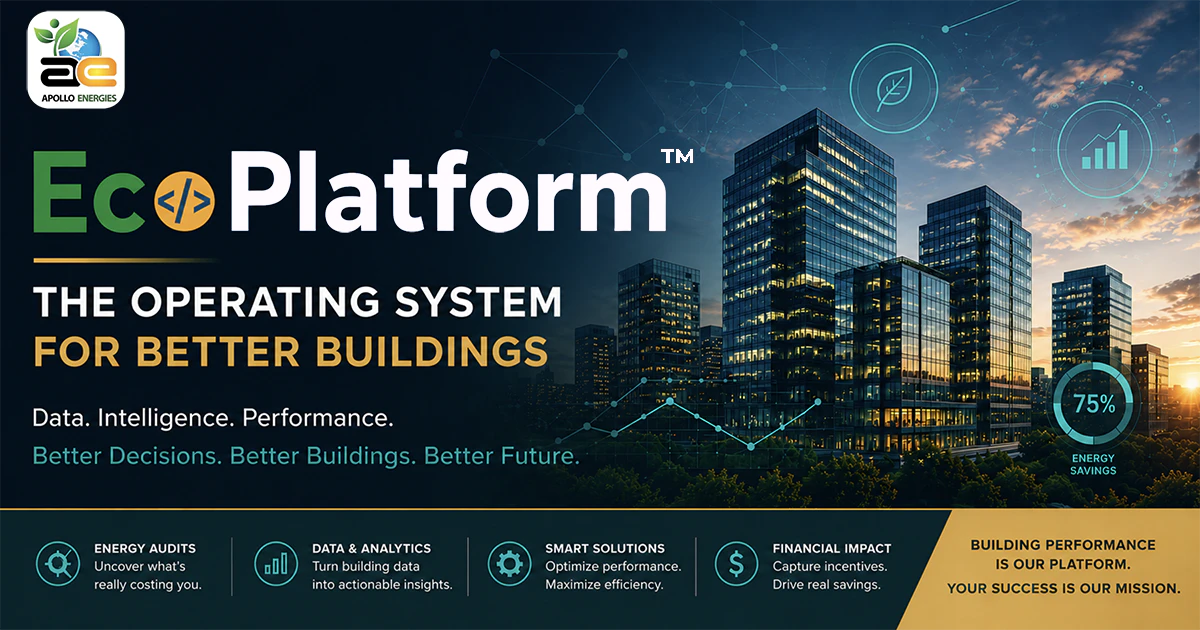
Apollo Energies is introducing EcoPlatform™, The Operating System for Better Buildings
A connected building-performance system that moves owners from discovery to prioritized action to completed improvements. EcoAudit® captures and structures building, utility, operating, and equipment data. EcoPlatform™ transforms that information into actionable intelligence and prioritized opportunities. RetroCore™ carries approved improvements through managed retrofit delivery, while preserving what was learned as part of the building’s permanent performance record. Together, EcoAudit®, EcoPlatform™, and RetroCore™ create one continuous path to better-performing buildings.
Speaker: Mark Stout, CEO, Apollo Energies
3:30-4:00pm ET
UpCodes presents - Cutting rework at the source with AI Plan Review
Rework is one of construction’s biggest sources of waste. See how UpCodes’ QA/QC platform catches code, spec, and coordination issues early, helping teams reduce unnecessary material and labor, protect project margins, and build more efficiently.
Speaker: Justin Mathis, Senior Account Executive, UpCodes
Sessions on Thursday, October 22
9:05-9:35am ET
Sphera Presents: Accelerating EPDs at Scale: The Asphalt Institute’s Blueprint for Repeatable Results
Demand for credible Environmental Product Declarations is growing as Buy Clean policies, transportation programs, green building standards and procurement requirements expand. Yet producing EPDs across multiple products, facilities and markets can remain complex and resource intensive.
In this technology showcase, the Asphalt Institute and Sphera will demonstrate how industry expertise, robust LCA methodology, high-quality data and purpose-built technology can turn one-off EPD projects into a more efficient, repeatable process. Drawing on the development of the Asphalt Institute’s industry-specific EPD solution, including industry-specific LCA datasets that better represent relevant materials, technologies, processes and regional conditions, the speakers will highlight practical ways to reduce manual effort, minimize rework and produce more consistent, credible and accurate LCA results at scale.
The session will conclude with a forward-looking discussion of digital, machine-readable EPDs and the data and process foundations organizations can establish today to prepare for more connected and interoperable environmental product information.
9:50-10:20am ET
Autodesk Presents: Advancing Construction Sustainability with Autodesk
From sourcing low-carbon materials to minimizing waste and rework, Autodesk can help construction teams build more sustainably. Learn how Autodesk Forma Takeoff embeds embodied carbon into preconstruction workflows, while connected building data in Forma Tandem helps owners optimize energy performance.
Speaker: Emily Edelston, Impact Growth Enablement Manager, Content & Tools, Autodesk
10:35-11:20am ET
mindfulMaterials presents: Multiple Sources, One Truth: How the CMF Translates Impact Data Across Platforms
Sustainability data doesn't live in one place — it's scattered across HPDs, EPDs, Declare labels, and a dozen different platforms, each speaking its own dialect. mindful MATERIALS' 2025 Data Ecosystem Report laid out a vision for connecting these dots: manufacturers as "Givers" of product data, technology platforms as "Receivers," and the Common Materials Framework (CMF) as the shared language in between.
This session moves that vision from paper to practice. Six leading technology platforms — Sustainable Minds, Ecomedes, Building Ease, Acelab, Green Badger, and Material Bank — join mM to unpack a newly developed, CMF-aligned common data schema that connects product impact data down to the individual datapoint level within the Climate Health and Human Health impact areas. Panelists will share why they're piloting cross-platform data sharing, what it took to align on a shared schema, and what's still standing in the way of a truly interoperable data ecosystem.
For the first time since last year's Data Ecosystem Report, mM will debut a live look at how the CMF is actually being used in the field — a cross-platform dashboard pulling real search and usage data from across the panelists' tools. Attendees will see what users are searching for, which project and market types are turning to the CMF most, which certifications and product categories surface most often, and how deep users are actually going — filtering at the level of a broad impact area, a sub-impact category, or a specific verified datapoint. It's the first public look at market behavior around the CMF at this level of granularity, straight from the platforms where that behavior happens.
Attendees will leave with a clear picture of how this pilot works in practice, what the field data reveals about real-world CMF adoption, and what it means for anyone trying to make faster, better-informed material decisions — regardless of which platform they use.
11:40-12:10pm ET
BrainBox AI Presents: Cloud BMS for Light Commercial Buildings: Enterprise Control Without the Enterprise Price Tag
Cloud BMS for Light Commercial brings enterprise-grade building automation to small-to-midsize commercial buildings, many for the first time. Facility managers remotely monitor, schedule, and control HVAC across multiple sites. Paired with BrainBox AI Stat 2, it connects to any brand's rooftop units, heat pumps, and economizers, with no on-premise servers.
12:25-12:55pm ET
Armstrong World Industries Presents: Beyond the Ceiling: The Energy, Carbon and Comfort Benefits of Phase Change Materials
Buildings account for significant carbon emissions — yet the ceiling is often overlooked as a sustainability tool. Explore how Armstrong Templok® Energy Saving Ceilings leverage phase change material to help save energy, enhance thermal comfort, and achieve net-negative carbon payback in 1–5 years, supporting your project's green building goals.
Speakers:
Mick Dunn, Product Manager, Energy Saving Ceilings, Armstrong World Industries
Deborah Pickens, Senior Manager, Energy Savings Customer Success, Armstrong World Industries
1:20-2:05pm ET
mindfulMaterials Presents: The Mindful Materials Common Material Framework: Getting to the Easy Button
For 25 years, LEED has pushed manufacturers and design professionals to make better choices in building material selection. The progress has been real — but the complexity hasn't gone away. Sustainability attributes remain fragmented, inconsistent, and difficult to navigate, leaving our industry without a shared language or a clear path forward. Mindful Materials is changing that.
The Common Material Framework (CMF) has done something our industry has long needed — it has brought the entire ecosystem to the same table. Manufacturers, design professionals, owners, and operators are now working from a unified framework, one built to simplify the complexity of material sustainability and move us closer to what everyone has been asking for: the materials easy button.
This session will give you an honest look at where the CMF stands today and where it is headed. You'll hear directly from the voices who are building it and using it — manufacturers integrating the framework into their product strategies, design professionals applying it in project specifications, and owners demanding it in their procurement standards. If you've ever felt overwhelmed by the volume of certifications, declarations, and sustainability claims competing for your attention, this session is for you. The CMF isn't just a tool — it's a shared commitment from our industry to stop making sustainability harder than it has to be.
2:20-3:05pm ET
mindfulMaterials Presents: Have you filled up a bucket today? How Common Material Framework Translates to a Common Material Language: Making the CMF Work for Everyone
We have the science. We have the certifications. We have the data. So why hasn't our industry scaled?
The honest question at the heart of this session is whether the complexity we've built around sustainability is actually changing human behavior — or whether it's slowing us down. As our industry works to address human health, climate health, circular economy, social responsibility, and ecosystem health through the building materials we specify and procure, are we getting closer to scale? Or are we still speaking a language that only a few people in the room can understand?
Mindful Materials developed the Common Material Framework to bring our entire ecosystem manufacturers, design professionals, owners, and operators onto the same page. The CMF organizes these critical impact areas into a shared structure, with the goal of developing programs that simplify this work across every sector. But programs only work when people can translate them into stories that empower others to participate, act, and lead.
That translation is the next frontier. It's called the Common Material Language. This session will explore how mindful materials members are doing exactly that, taking the rigor of the CMF and turning it into clear, compelling, human language that moves people to act. You'll hear from manufacturers, design professionals, and owners who are developing their own common material language and using it to grow our ecosystem, deepen engagement, and make sustainability something everyone can find themselves in.
If science alone hasn't been enough, language might be the answer. Come learn how we get there together. The framework is built. Now let's learn how to speak it.


